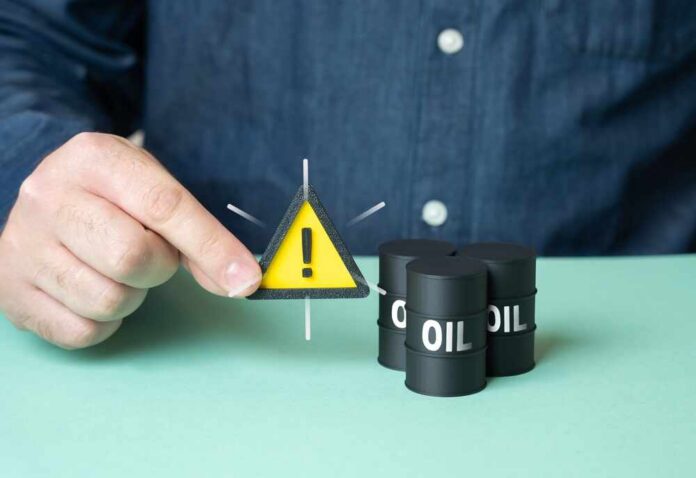
Oil did not just slip after the U.S.–Iran deal; it fell hard enough to remind everyone how fragile “cheap gas” really is.
Story Snapshot
- Oil prices dropped to their lowest level since early March right after Trump signed the Iran deal.
- The peace framework promises a reopened Strait of Hormuz, but many key security issues remain unresolved.
- Markets cheered with rising stocks and falling crude, even while experts warned the calm could be temporary.
- Conservatives see both a win for American drivers and a test of whether Iran can be trusted to keep the oil flowing.
Oil falls fast, markets cheer, and everyone asks the same question: will it last?
Traders did not wait for fine print when word hit that President Trump and Iran agreed to a peace framework that would reopen the Strait of Hormuz.
Oil futures plunged, with Brent crude falling around 4% and United States benchmark crude dropping close to 5% in a single session, sending prices to their lowest levels since early March. Financial markets snapped into classic “relief mode” as stock index futures jumped and the war risk premium in oil burned off almost overnight.
For anyone filling up a pickup or running a small business, those price moves are not abstract. Analysts on financial networks said crude had already slipped about 5%, and some fuel experts projected that if the peace framework holds, average gasoline prices could drift down well below recent highs in the coming weeks. That is exactly how markets should react when a major energy choke point goes from “maybe war” to “maybe open,” at least on paper.
What the U.S.–Iran deal actually promises on paper
The agreement, as described by American and foreign outlets, is not a final treaty but a memorandum of understanding that creates a 60‑day ceasefire window and a path to reopen the Strait of Hormuz to commercial shipping.[2][3]
The United States pledged to lift its naval blockade on Iranian ports within about a month, while Iran agreed to allow tankers and cargo vessels to pass again through the strait, which had been effectively choked off during the conflict. European governments said they stood ready to ease some sanctions tied to energy and shipping once the deal is fully in force.
Oil prices plunge to lowest levels since early March after Trump signs Iran deal https://t.co/Ca9UL0iYsL
— FOX Business (@FoxBusiness) June 15, 2026
Trump told supporters that ships were already beginning to move and that the Strait would be “completely open” and “toll‑free,” framing the deal as both a peace win and an energy win for the world.[4] That message landed well with markets hungry for good news.
Roughly a fifth of global oil trade normally moves through that narrow waterway, so even the promise of normal traffic acts like a pressure valve on prices the moment traders believe it.[3]
The missing details that keep serious people nervous
Beneath the headlines, the deal’s weak points line up like warning lights on a dashboard. Reporters who saw briefings were clear that this is a preliminary framework, not a signed, final peace settlement, and that exact terms of how and when Hormuz fully reopens remain vague.[3]
Nuclear limits, sanctions relief, and verification rules are pushed into future talks, which means the “grand bargain” people imagine does not yet exist in law or concrete procedure.[1][2]
Insurance companies and ship owners add another speed bump. Coverage costs for sailing near Iran surged during the war, and early expert commentary warned that those marine insurance premiums will not drop to normal until the risk of mines, stray missiles, or sudden policy reversals looks much lower and more durable.
Energy analysts told outlets that real normalization of oil flows through Hormuz could take three to six months even under a best‑case scenario. Markets may have moved ahead of reality, which is exactly how price spikes also happen when things go wrong.
Unresolved conflicts, Iranian leverage, and skepticism
The toughest questions are not about tanker schedules; they are about missiles and militias. Reporting from regional and international channels stresses that Iran’s ballistic missile program and its support for armed groups like Hezbollah, Hamas, and the Houthis are not settled in this framework.
Israeli strikes in Lebanon have continued, and Israel was not a party to this understanding at all, even though Iran tied parts of its cooperation to a halt in attacks on Hezbollah. That gap alone makes long‑term stability a shaky bet.
Then there is the toll question, which cuts straight to sovereignty and leverage. Trump publicly promised a “permanently toll‑free” Strait, but coverage citing Iranian positions says Tehran still wants the right to regulate and possibly charge for passage.
From a common‑sense view, this clash matters. A free and open waterway that keeps global energy costs down is in America’s interest. Handing Iran a lasting revenue lever over a fifth of the world’s oil shipments is not.
What this means for American families and long‑term energy security
Even with all the uncertainty, the short‑term benefits are real. Lower crude prices ease stress on families, truckers, and small manufacturers, and they give breathing room to a world economy that had been straining under higher fuel costs.
Markets reacted as they always do when war fears ease near a key energy route: oil down, stocks up, safer‑asset yields lower, risk appetite back on. That is a rational, textbook response to de‑escalation, even if it rests on hope more than proof.
The deeper lesson points in a direction many have argued for years. When the price at your local gas station depends on whether hard‑to‑trust regimes along a narrow foreign strait keep their word, that is not real security.
The sharp drop in prices after this deal shows how much “fear tax” was baked into oil. The open question, and the one that should shape policy, is whether America uses this brief relief to strengthen its own energy independence before the next crisis tests the market again.
Sources:
[1] Web – Oil prices plunge to lowest levels since early March after Trump signs …
[2] YouTube – US and Iranian negotiators reach deal to re-open strait of …
[3] Web – U.S. and Iran announce a deal to end the war, reopen …
[4] Web – US and Iran sign ceasefire agreement, details remain unclear