Astronomers just found sugar floating in the space between stars — and it raises a question scientists have been circling for decades.
Story Snapshot
- Researchers detected erythrulose, a four-carbon sugar molecule, in a dense molecular cloud near the center of our galaxy.
- This marks the first time a four-carbon sugar has ever been found in interstellar space.
- The discovery builds on a long history of finding complex organic molecules drifting between stars.
- Scientists say the find adds to the case that key building blocks of life may form in space before reaching planets.
The First Sugar Ever Found Between Stars
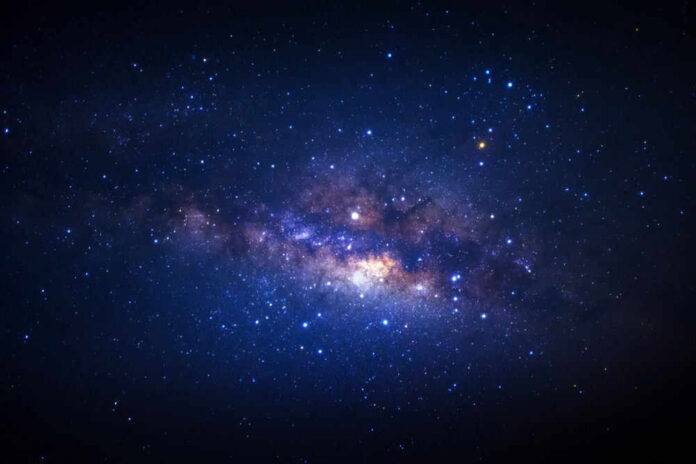
A team led by astronomer I. Jimenez-Serra found erythrulose in a molecular cloud called G+0.693-0.027, located near the center of the Milky Way. This region is famous for its rich chemistry.
Scientists used two powerful radio telescopes — the Yebes 40-meter dish in Spain and the IRAM 30-meter telescope in France — to detect the faint radio signals emitted by the molecule. The detection method works because molecules spin in space, and each one spins at its own unique frequency, like a fingerprint.
Erythrulose—a sugar found in raspberries—is also prevalent in a giant molecular cloud close to our galaxy’s core, scientists have discoveredhttps://t.co/n0mryHxQLH
— Scientific American (@sciam) July 13, 2026
Erythrulose is a ketose sugar, meaning it has a specific arrangement of carbon and oxygen atoms. It has four carbon atoms in its chain, making it more complex than simpler molecules previously found in space. What makes it especially interesting is that it is chiral — it exists in two mirror-image forms, just like your left and right hands.
That property matters a great deal in biology because living things on Earth use only one chiral form of molecules. Whether space chemistry plays a role in that pattern is one of the big open questions this discovery feeds into.
Decades of Sugar Hunting in Space
This find did not come out of nowhere. Scientists have been hunting for sugar-related molecules in space for more than two decades. Back in 2000, astronomers detected glycolaldehyde, a simple two-carbon sugar molecule, in a gas cloud called Sagittarius B2. That was a landmark moment.
Then, in 2004, a team using the National Science Foundation’s Green Bank Telescope confirmed the presence of glycolaldehyde again in a star-forming region. Each step up the carbon chain is a bigger deal because more complex sugars are closer to those that actually show up in living cells.
The asteroid connection makes this even more compelling. Researchers recently found ribose — a five-carbon sugar that forms the backbone of RNA — inside samples returned from asteroid Bennu. Ribose is not just any sugar.
It is a core ingredient of the molecules that carry genetic information in every living thing on Earth. Finding sugars first in interstellar clouds, then in asteroids, then potentially on planets paints a picture of chemistry that travels across the cosmos.
What This Find Actually Means — and What It Does Not
Here is where clear thinking matters. Erythrulose is not a sugar you stir into coffee. It does not prove life exists elsewhere. What it does show is that the chemistry needed to build life can happen in the cold, dark space between stars — without any biology involved at all.
That distinction is important. Scientists have a habit, understandable but worth watching, of sliding from “we found a building block” to “life could be everywhere.” Those are two very different claims.
The honest read on this discovery is that it is genuinely exciting for chemistry and for understanding how organic molecules spread through the galaxy.
Over 200 molecules have now been detected in the interstellar medium. Each new one raises the ceiling on what non-biological chemistry can produce.
Whether any of it ever assembles into something living — somewhere, sometime — remains unknown. But the raw ingredients keep showing up in places no one expected. That alone is worth paying attention to.
Why the Galactic Center Keeps Delivering Surprises
The molecular cloud where erythrulose was found lies near the Galactic Center, a region rich in gas, dust, and radiation. It is one of the most chemically active spots in the galaxy. Scientists keep pointing their telescopes there because the density of material makes detection easier.
Think of it as the universe’s best-stocked chemistry lab. The molecules found there likely form on the surfaces of tiny dust grains, where atoms slowly combine over thousands of years in near-absolute-zero conditions. Warmth from nearby stars eventually releases them into the gas, where telescopes can catch their signals.
The paper is currently a preprint, meaning it has not yet completed formal peer review. That is standard practice in astronomy, where sharing results quickly allows other teams to check and build on the work.
The core detection — the spectral fingerprint of erythrulose — rests on solid, well-established methods. The broader implications for life’s origins will take longer to sort out, as they always do. But the sugar is real, it is out there, and the universe just got a little sweeter.
Sources:
abcnews.com, ehu.eus, arxiv.org, universetoday.com, nrao.edu, reddit.com