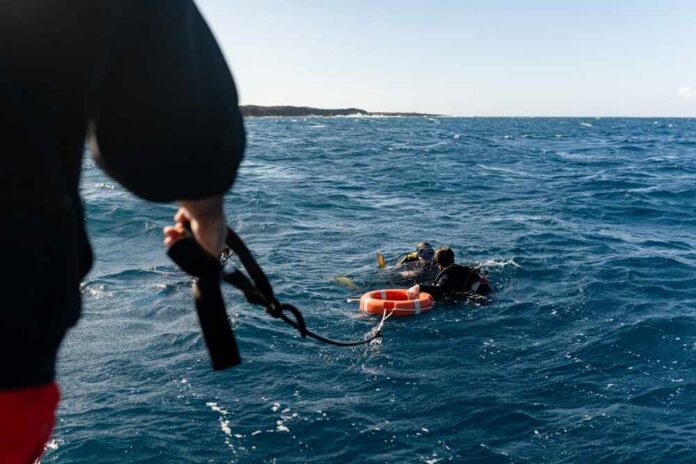
The most haunting detail of the Kennedy Shoal shark attack is not the predator, but the hour-long fight for life as three mates raced a dying spearfisher back to shore, knowing they were losing.
Story Snapshot
- A 39-year-old spearfisher from Cairns died after a shark struck his head at Kennedy Shoal on the Great Barrier Reef.[1][3]
- He was diving with three friends who dragged him from the water and sped over an hour to reach paramedics on shore.[1]
- The attack was Australia’s second fatal shark incident involving a spearfisher in just over a week.[3]
- The case reignites questions about personal risk, shark management, and how far society should go to tame wild nature.[3]
A routine spearfishing trip turns into a fatal fight for survival
Four men launched a boat toward Kennedy Shoal, about 40 kilometers offshore from far north Queensland, for what was meant to be a standard spearfishing run on the Great Barrier Reef.[1][2]
The victim, a 39-year-old Cairns spearfisher, entered familiar water: clear reef, baitfish, and the usual background presence of sharks that every serious diver mentally files under “normal risk.”[2] That familiarity is exactly what makes the violence that followed so jarring for anyone who spends time in the ocean.
Shark kills spearfisher in front of friends in Australia: "Terrifying thing to see" https://t.co/LLVfE7X9jr
— CBS News (@CBSNews) May 25, 2026
Emergency services later confirmed that a shark struck the spearfisherman in the head while he was underwater, inflicting a critical injury that would ultimately prove unsurvivable.[1][3]
One of his friends was close enough to haul him out of the water in the middle of the attack zone, with at least two more mates still in the vicinity and a large predator somewhere below.[1]
That detail alone—choosing to turn toward danger to pull a friend out—lands hard with anyone who values courage and brotherhood.
The brutal arithmetic of distance, time, and remote risk
Once the men got him back on the boat, the next enemy was not the shark but geography.[1] Kennedy Shoal sits roughly an hour’s run from the nearest ramp at Hull Heads, so the group had no option but to open the throttle and race for land with a mortally wounded man on deck.[1]
When they reached the boat ramp more than an hour after the bite, paramedics could only declare him dead.[1] That timeline underscores a hard truth: remote adventure comes with built-in limits on what emergency medicine can do.
Police and reporters described the injury as a critical head wound from a shark bite, and there has been no serious public dispute about the fundamental facts: shark attack, spearfisher, Kennedy Shoal, fatal outcome.[1][3] This is not one of those ambiguous maritime cases where no one knows what happened.
It is a stark, documented sequence: man dives, shark hits, mates recover him, long run to shore, death at the ramp.[1] The lack of controversy around the event itself puts the spotlight instead on what it represents.
Second fatality in a week and a growing sense of pattern
National and international coverage quickly linked this case to another fatal spearfishing attack just days earlier off Western Australia, where a shark killed an experienced diver near Rottnest Island.[1][3]
Wire services and broadcasters framed Kennedy Shoal as Australia’s second fatal shark incident in about a week, both involving spearfishers hunting in known shark habitats.[1][3]
That pattern raises an uncomfortable but necessary question: how much risk is acceptable when recreation overlaps with the business end of the food chain?
Spearfisher Killed in Shark Attack on Great Barrier Reef Off North Queensland https://t.co/Sroh16gsTv
— diverdowndeep (@diverdowndeep) May 25, 2026
Spearfishing around reefs frequented by apex predators will always carry more risk than a patrolled suburban beach. The men involved were adults, not naïve tourists, and their decision to enter the water implies acceptance that the ocean is not a theme park.
Any serious policy conversation has to start by acknowledging that reality rather than pretending danger can be regulated away.
Shark control, public safety, and the limits of managing nature
This death feeds into a recurring Australian debate: whether authorities should increase shark control measures, such as drum lines or targeted culls, after fatal attacks.[3]
Advocates argue that human life deserves priority and that popular fishing and diving grounds justify assertive management.[3] Opponents warn that reactionary culling can damage marine ecosystems without delivering reliable safety, especially in remote, lightly monitored areas like Kennedy Shoal.[3]
Both sides accept one constant: the government cannot make the wild ocean safe in the same way it polices city streets.
For older readers who grew up before risk aversion became a cultural reflex, the Kennedy Shoal tragedy serves as a grim but familiar reminder: nature sets the rules, not bureaucrats.[3]
Men still seek challenge, solitude, and meat in places where no ambulance can arrive in ten minutes. This attack does not prove that the ocean is out of control; it proves that some Australians still live close enough to real danger that a wrong moment can cost everything, even with loyal friends and a fast boat.
Sources:
[1] Web – Spearfisher mauled in Australia’s second fatal shark attack in a week
[2] YouTube – Spearfisherman killed in Great Barrier Reef shark attack | 7NEWS
[3] YouTube – Spearfisherman dies after shark attack at Kennedy Shoal