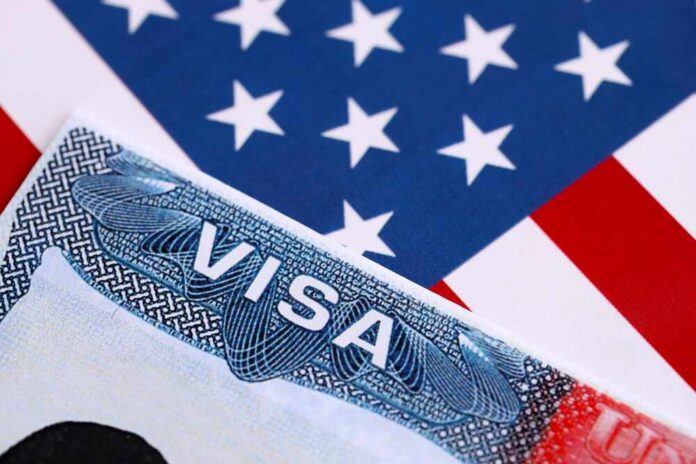
A little-known move by federal regulators could let banks treat your immigration status as a key factor in whether you get a mortgage or credit card.
Story Snapshot
- The Consumer Financial Protection Bureau (CFPB) says lenders may consider immigration status when judging if borrowers can repay loans.
- The Trump administration’s team argues this simply enforces long‑standing law that protects banks when a borrower could be removed from the country.
- Earlier Biden‑era warnings against using immigration status were withdrawn as confusing and too hard on lenders.
- Banks are now caught between fair‑lending rules and pressure to avoid risky loans in an unstable economy.
CFPB says immigration status can matter for loan repayment
The Consumer Financial Protection Bureau’s new Federal Register statement says federal law already requires banks to judge whether a borrower can reasonably repay a mortgage or certain other credit before making the loan.[6]
That law, the Truth in Lending Act, and its Regulation Z rule tell lenders to look at income, employment, and other factors tied to repayment.[6] The bureau now stresses that a person’s immigration or work status can be one of those factors when it clearly affects future income or the bank’s ability to collect.[6]
Trump admin to tell banks immigration status may be considered in mortgage, credit decisions https://t.co/hedlN1qJbC
— FOX Business (@FoxBusiness) June 4, 2026
The bureau explains that if government records show a borrower’s permission to stay in the United States may end soon, that could disrupt income and raise the risk of nonpayment.[6]
In those cases, the agency says lenders may even be required to review immigration status to meet their duty to judge ability to repay.[2][6] This is not written as a brand‑new rule, but as guidance on how banks should read existing law in light of repayment risk.[6]
Earlier discrimination warnings pulled back as confusing
This stance comes after a sharp change from the Biden years. In 2023, the Justice Department and the bureau issued a joint statement warning that using immigration status the wrong way could amount to illegal discrimination based on race or national origin under the Equal Credit Opportunity Act.[1][5]
That document reminded banks they may not deny credit based only on a person’s real or perceived immigrant status.[1] It also said “overbroad” use of status, especially if tied to bias, could break the law.[1]
In January 2026, the agencies withdrew that earlier statement, saying it risked clashing with the plain text of the Equal Credit Opportunity Act and its Regulation B rule.[3]
The withdrawal notice explains that for decades those rules have allowed lenders to consider lawful residence and other information needed to protect their rights to repayment.[3] Officials said they wanted to clear up any “confusion” about when immigration status can be used, and to avoid extra compliance burdens that may have pushed banks to overcorrect out of fear of government lawsuits.[3][4]
Where the law draws the line between risk and discrimination
The legal line is narrow and tricky. The Equal Credit Opportunity Act bars discrimination based on race, national origin, and several other traits, but it does not explicitly forbid using immigration status itself.[4][5]
Regulation B says creditors may consider an applicant’s immigration or citizenship status when needed to protect repayment rights.[4][5] At the same time, the earlier joint statement, which still reflects how fair‑lending staff think, stressed that “unnecessary or overbroad reliance” on immigration status might still violate the law if it acts as a stand‑in for national origin or race.[1]
For lenders, that means they can consider status, but only when it is clearly tied to repayment risk, like a work visa that expires before a 30‑year mortgage will be paid off.[1][6] They are not supposed to use status as a blanket excuse to shut out whole groups of legal immigrants who can repay.[1]
The new Trump‑era guidance leans harder on the risk side, reminding banks that they must not ignore evidence that a borrower may be forced to leave the country and lose income.[2][6] Yet it does not erase the older warning that bias or sloppy rules could still bring investigations.[1][3]
What this means for citizens, legal immigrants, and illegal entrants
For American citizens and legal immigrants with solid status, this approach can be a safeguard for the whole system. When banks are free to consider real risk, they are less likely to repeat the reckless lending that helped fuel the 2008 crash.[6]
The bureau itself ties the guidance to ability‑to‑repay rules that were created to stop lenders from handing out loans that borrowers clearly cannot afford.[6] Readers know who pays when those loans fail: savers, retirees, and working families who see their home values collapse and bailouts explode the national debt.
Michael May | https://t.co/8hijpqtunt CFPB guidance points mortgage lenders to consider borrower immigration status. CFPB guidance says immigration status may affect ability to repay. Lenders could need to weigh… https://t.co/7PKB4EDBlE #RealEstate #Housing #forex #SWFL #EURO
— MICHAEL MAY (@_MikeMayRealtor) June 5, 2026
For people in the country illegally, or with shaky legal status, the message is different. If removal from the United States is a real possibility during the life of the loan, lenders now have clear cover to factor that risk into their decision.[2][6]
That means fewer chances to game the system, walk away from debts, and leave taxpayers and stable borrowers holding the bag. At the same time, because anti‑discrimination law still applies, banks that go too far and use status as a mask for bias can still face enforcement.[1][3][5]
Sources:
[1] Web – Trump admin to tell banks immigration status may be considered in …
[2] Web – CFPB: Creditors may be required to check immigration status
[3] Web – Justice Department and Consumer Financial Protection Bureau …
[4] Web – CFPB and DOJ withdraw ECOA guidance on immigration status in …
[5] Web – ECOA | Consumer Finance Insights (CFI)
[6] Web – CFPB and Justice Department Issue Joint Statement Cautioning that …