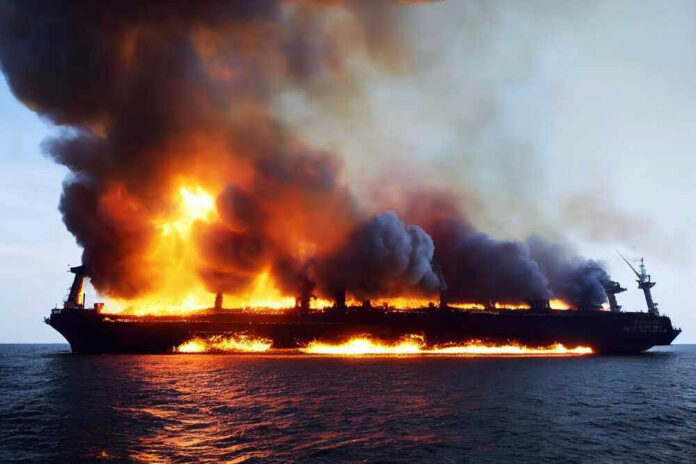
America just demonstrated—far from the Middle East—that U.S. naval power can reach and strike on its terms, and the ripple effects are headed straight for global shipping and energy markets.
Watch the video below this post.
Quick Take
- Pentagon officials say a U.S. Navy submarine sank Iran’s frigate IRIS Dena with torpedoes in international waters off Sri Lanka on March 3–4, 2026.
- Sri Lankan authorities reported at least 80 deaths and 32 survivors rescued after a distress call and rapid response by local forces.
- Defense Secretary Pete Hegseth framed the strike as a major milestone, while the Joint Chiefs’ chairman narrowed the “first since WWII” claim to U.S. submarine torpedo sinkings since 1945.
- The incident broadens a fast-moving U.S.-Israel campaign against Iran and raises immediate risks for regional escalation and energy disruption tied to the Strait of Hormuz.
Pentagon confirms torpedo sinking off Sri Lanka
Defense Secretary Pete Hegseth told reporters that a U.S. Navy submarine sank the Iranian frigate IRIS Dena with a torpedo strike in waters south of Sri Lanka.
Officials said the attack occurred late March 3, with Sri Lanka receiving a distress call at 5:08 a.m. local time on March 4 reporting an explosion aboard the ship. Pentagon-released footage showed the torpedo impact as the ship broke apart.
Sri Lankan officials said the incident happened outside the country’s territorial waters, near the island’s southern coast, and that Sri Lanka’s navy dispatched rescue assets within roughly an hour of the distress call. {
Reporting from Sri Lanka indicated 32 crew members were rescued and at least 80 deaths were confirmed, with additional search activity underway.
Iran did not immediately provide a public accounting in the research provided, though it was described as raising accusations through diplomatic channels.
“First since WWII” claim needs careful parsing
Hegseth characterized the attack as the first torpedo sinking of its kind since World War II, a headline-grabbing claim that drew immediate scrutiny.
The research provided includes a key clarification: Joint Chiefs Chairman Dan Caine described it as the first U.S. submarine torpedo sinking since 1945, which is a narrower statement than “first in the world.”
Fact-checking references cited post-WWII torpedo sinkings by other nations, including the Falklands War and a 1971 conflict.
That distinction matters because credibility in wartime briefings is not a side issue—it shapes deterrence, public trust, and allied confidence. Pentagon footage and consistent reporting across outlets support the core fact pattern: the IRIS Dena sank after a torpedo strike, and Sri Lankan authorities handled rescue operations.
The parts that remain less clear in the available research include the specific submarine involved, the torpedo type, and operational details beyond what is conveyed in the video and briefing language.
Why this location and target change the strategic picture
Officials placed the strike in the Indian Ocean roughly 44 nautical miles off Galle, Sri Lanka—geographically distant from the Persian Gulf hotspots Americans associate with U.S.-Iran tensions.
The research describes IRIS Dena as Iran’s newest frigate, equipped with anti-ship and surface-to-air missiles and torpedo launchers, suggesting that Tehran was fielding a more capable platform.
A strike this far from the Middle East also signals reach: Iran cannot assume its naval assets are insulated by distance or by operating outside the Gulf.
The broader context in the research is an accelerating U.S.-Israel campaign sometimes labeled “Operation Epic Fury,” with strikes hitting Iranian missiles, air defenses, and leadership in the days prior to the sinking.
The research also states Iran retaliated with missile attacks and halted Strait of Hormuz oil shipments—an economic pressure point that historically drives global price shocks.
If shipping disruption persists, the near-term consequences will likely manifest as energy volatility and higher costs that hit households directly.
Domestic stakes: deterrence, transparency, and avoiding open-ended war
Hegseth said the United States would fight “for as long as we need to,” and he paired the announcement with sweeping language about U.S. control of Iranian airspace and the degraded state of Iran’s navy.
The research also notes politically charged statements tied to an alleged plot against President Trump, though the underlying details are not fully documented in the provided materials.
For Americans who watched years of soft messaging and strategic drift, the administration’s posture is unmistakably different—and deliberately so.
At the same time, the reporting available here leaves gaps that matter in a constitutional republic: the legal rationale, the rules of engagement, and the full scope of U.S. commitments as the conflict expands.
The strongest verified facts in the sources are the location, the confirmed sinking, the casualty figures provided by Sri Lanka, and the “first since 1945 for U.S. subs” clarification.
Beyond that, readers should separate confirmed battlefield outcomes from rhetorical framing while watching for clearer public explanations of objectives and end state.
Sources:
US submarine strike sinks Iranian warship for first time since WWII, Department of War says
United States Sinks Iranian Warship, Pentagon Briefing