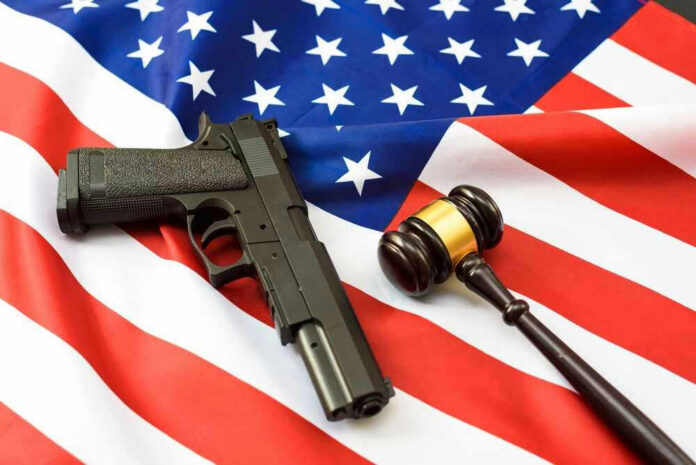
Hawaii’s gun control scheme just got slapped down by the Supreme Court, and the ruling is a major win for Second Amendment rights.
Quick Take
- The Supreme Court struck down Hawaii’s law requiring permission to carry guns in stores and hotels.[1]
- The 6-3 ruling means guns can be carried on private property open to the public unless the owner says no.[1][2]
- The Court said Hawaii’s rule fits the plain text of the Second Amendment and is presumptively unconstitutional.[5][6]
- Business owners still keep control and can ban firearms by posting clear signs.[2][5]
What the Supreme Court Decided
The Supreme Court ruled 6-3 that Hawaii cannot force law-abiding gun owners to seek permission before entering stores, hotels, and similar businesses with a firearm.[1][5]
The majority said the law falls within the plain text of the Second Amendment and is therefore presumptively unconstitutional.[5][6] That matters because it pushes back on the kind of state-level gun restriction many see as a direct attack on lawful carry.
The decision reached beyond Hawaii’s borders because it affects private property open to the public unless the owner clearly bans guns.[1][2] That means the default rule now favors the armed citizen, not the state bureaucracy. The ruling also lines up with the Court’s recent approach in gun cases, where judges have demanded a real historical basis before states can limit carry rights.[6][18]
Why Hawaii Lost
According to the Court’s opinion, the petitioners are among “the people” protected by the Second Amendment and they seek to “bear” arms for self-defense.[6] That language matters because it ties the case directly to the core constitutional right recognized in District of Columbia v. Heller and later cases.[18][21] In plain terms, the justices said Hawaii tried to turn a constitutional right into a permission slip.
This is sure to be a landmark Supreme Court case. After all, it’s a win for every law-abiding American who carries a firearm for self-defense. https://t.co/WPwTYBGdYT
— Rand Paul (@RandPaul) June 28, 2026
Hawaii had defended its law as a way to protect the public, and supporters cast it as a common-sense safety measure.[2][11] But the majority did not accept that framing. The Court rejected the idea that local culture or policy goals can override the Constitution, including the state’s “spirit of Aloha” argument.[2] For many readers, that will sound familiar: blue states keep finding new ways to chip away at gun rights.
What Remains Legal After the Ruling
The ruling does not erase a property owner’s right to control who enters private land with a gun.[2] Business owners still may prohibit firearms by posting signs or giving clear notice.[2][5] The Court also left sensitive places like schools and polling places untouched, so this was not a blank check for carry everywhere.[2] It was a direct rejection of Hawaii’s default no-carry rule for public-facing businesses.
Supreme Court strikes down Hawaii law requiring permission to carry guns in stores.
The ruling allows licensed gun owners to carry firearms into businesses unless owners clearly prohibit them.
The court ruled the law violated the Second Amendment.
Source: NewsForce
Host:… pic.twitter.com/uL67uxJT91— NewsForce (@Newsforce) June 27, 2026
That limit matters, because gun-control groups are already trying to frame the decision as if it made every store a forced gun zone.[2][7] The record says otherwise. The Court only said the state cannot presume guns are banned unless a business grants permission.[1][2]
In other words, the burden shifted back where many conservatives believe it belongs: on government officials who want to restrict a protected right.
Why This Case Will Keep Echoing
The case also shows how the Supreme Court’s current majority is treating Second Amendment disputes. Hawaii leaned on history, including a Louisiana Black Codes example from 1865, but the majority still held that the challenged law conflicts with the Constitution’s text.[2][5]
That leaves less room for states that want to invent new gun rules and call them old traditions. For gun owners, that is a welcome brake on government overreach.
The ruling is likely to fuel more backlash from states that already dislike the Court’s gun decisions.[2] Groups opposed to the ruling are calling it flawed and warning that lawmakers in places like New York, New Jersey, Maryland, and California may look for new workarounds.
[2] That is exactly the fight many Americans are tired of: one court says the Constitution means what it says, and activist states rush to dilute it again.
Sources:
[1] Web – Supreme Court strikes down Hawaii law requiring permission to carry …
[2] Web – Wolford v. Lopez – Oyez
[5] Web – WOLFORD V. LOPEZ, No. 23-16164 (9th Cir. 2024) – Justia Law
[6] Web – [PDF] 24-1046 Wolford v. Lopez (06/25/2026) – Supreme Court
[7] Web – WOLFORD v. LOPEZ | Supreme Court – Law.Cornell.Edu
[11] Web – Supreme Court bars ‘vampire rules’ on gun ownership – NPR
[18] Web – Permission to enter, with a gun? Justices look to defang Hawaii’s …
[21] Web – [PDF] The Second Amendment and States’ Rights: A Thought Experiment