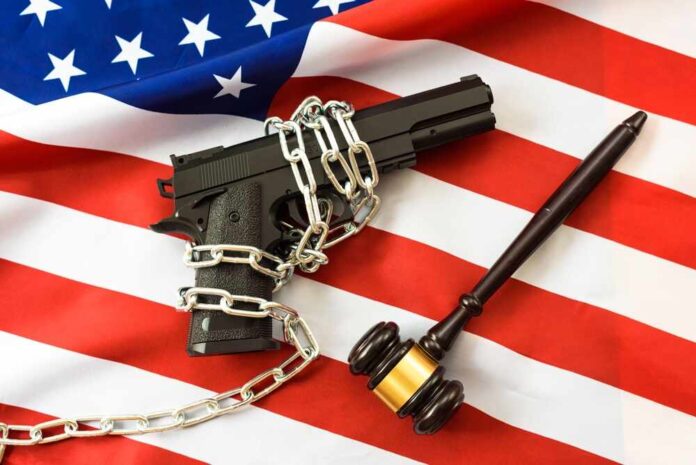
The Supreme Court signaled it may strike down Hawaii’s extreme gun restriction that effectively bans concealed carry across 96% of accessible land, a shocking violation of Second Amendment rights that treats lawful gun owners like criminals.
Story Snapshot
- Six Republican-appointed justices appeared sympathetic to a constitutional challenge against Hawaii’s restrictive gun law requiring express permission to carry on private property open to the public
- Hawaii’s law affects 96.4% of publicly accessible land in Maui County, covering stores, malls, restaurants, theaters, and beaches
- Trump administration supports challengers, warning Hawaii’s approach opens floodgates to endless gun regulations disguised as property rights
- Only five states impose such restrictive default rules, while 45 states presume licensed carriers can carry unless explicitly prohibited
Hawaii’s Extreme Outlier Status Draws Scrutiny
Hawaii stands as one of only five states demanding gun owners obtain explicit permission before carrying firearms on private property open to the public. The remaining 45 states recognize the constitutional rights of licensed carriers, allowing them to carry unless property owners post clear prohibitions.
This radical departure from national norms affects virtually every aspect of daily life in Hawaii, covering shopping centers, restaurants, theaters, farms, and even private beaches. Violations carry criminal penalties of up to one year in prison, turning law-abiding citizens exercising constitutional rights into potential felons.
Chief Justice Roberts suggests that Hawaii’s restrictions on concealed carry treat the 2nd Amendment as a “disfavored” and “second level” right compared to other constitutionally-protected freedoms. @FDRLST pic.twitter.com/M1sHhVjRVP
— Shawn Fleetwood (@ShawnFleetwood) January 20, 2026
Justices Challenge Weak Historical Arguments
During January 20, 2026, oral arguments in Wolford v. Lopez, the Supreme Court’s conservative majority aggressively questioned Hawaii’s historical justifications. Justice Neil Gorsuch pointedly criticized the state’s reliance on an 1865 Louisiana law, enacted as part of racist Black Codes designed to disarm freed slaves, calling it an extreme “outlier” rather than legitimate precedent.
Chief Justice John Roberts highlighted constitutional inconsistencies, questioning why campaign workers can access private homes under First Amendment protections while Second Amendment rights receive discriminatory treatment.
The Trump administration’s representative, Principal Deputy Solicitor General Sarah Harris, warned that Hawaii’s approach creates a dangerous precedent, enabling unlimited gun regulations masked as property rights concerns.
Constitutional Rights Versus Property Control
Hawaii’s attorney Neal Katyal argued the law simply requires gun carriers to obtain property owner consent, framing it as respect for private property rights rather than Second Amendment infringement. Gun safety advocate Douglas Letter characterized the requirement as “eminently reasonable,” suggesting asking permission represents minimal burden.
However, plaintiffs’ counsel exposed this argument as fundamentally flawed, noting that Hawaii created a unique “vampire rule” where gun owners need an affirmative invitation rather than a simple absence of prohibition. This framework subjects only Second Amendment rights to such extreme restriction, discriminating against constitutionally protected activity while other rights receive standard treatment.
Nationwide Implications for Gun Rights
A ruling against Hawaii would immediately restore Second Amendment protections to licensed carriers while preserving property owners’ ability to prohibit firearms through posted signage or verbal notification.
This shift would affect the four other states with similar permission-based defaults and establish critical precedent following the 2022 Bruen decision requiring gun regulations align with historical tradition. Businesses and property owners would need explicit policies rather than government-imposed blanket bans.
The decision, expected by June 2026, will clarify whether states can effectively nullify constitutional rights through administrative burdens. Gun owners nationwide understand this case represents the difference between recognizing constitutional rights and allowing government manipulation to render those rights meaningless.
The oral arguments revealed judicial skepticism toward Hawaii’s attempt to circumvent Bruen through property rights arguments. Justice Ketanji Brown Jackson’s suggestion that the case involves property rather than Second Amendment rights demonstrates the creative legal gymnastics gun control advocates employ to justify restrictions.
However, six Republican appointees appeared unified in recognizing Hawaii’s law as constitutional overreach. Plaintiff’s counsel Kevin O’Grady expressed confidence the justices will reject the lower court’s approval, stating such extreme restrictions “will not be tolerated by the U.S. Supreme Court.”
This case underscores the ongoing battle to protect constitutional rights against states determined to disarm citizens through regulatory manipulation.
Sources:
Supreme Court Considers Hawaii Gun Law – TPR
Hawaii AG to Supreme Court: Gun Control is Hawaiian Tradition – Civil Beat
Supreme Court Appears Sympathetic to Gun Owners’ Challenge to Hawaii Law – SCOTUSblog
Gun Rights, Private Property Debated at Supreme Court – Fox News
Supreme Court Weighs State Limits on Carrying Guns on Private Property – ABC News