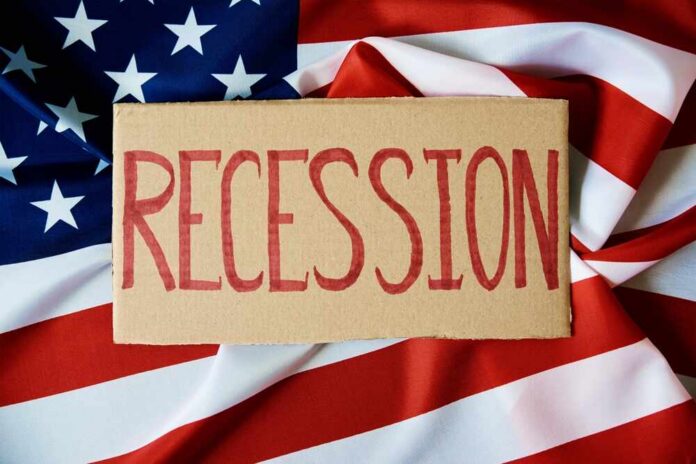
America’s economy may be one policy mistake or one oil shock away from tipping into a recession that markets refuse to see coming.
Story Snapshot
- Moody’s Analytics chief economist Mark Zandi pegs U.S. recession odds at 40%, nearly triple the long-run norm he cites at about 15% [1][5].
- Labor-market momentum is fading beneath the headline rate, with Zandi warning job growth has “nearly stopped” and negative payroll prints are plausible [5].
- Real disposable income and spending look flat, exposing middle- and lower-income households to shocks [1][5].
- Elevated stock prices appear concentrated in artificial intelligence winners rather than broad fundamentals, heightening correction risk [1].
Zandi’s 40% Recession Call And Why It Stings
Mark Zandi did not hedge the discomfort: a 40% recession probability is “very elevated” and “very uncomfortable” relative to the roughly 15% historical baseline he cited [1][5].
He framed the economy as fragile, not doomed—and that nuance matters. He pointed to weakened growth engines that do not make headlines but run the machine: slower job creation, soft real incomes, and spending that has lost steam. He also kept the door open to avoidance if policy steers clear of unforced errors [4].
Top economist sounds alarm on America’s 40% recession risk, warns stocks are disconnected from reality https://t.co/57286XAjZr
— FOX Business (@FoxBusiness) May 20, 2026
Stocks complicate the picture. Zandi argued that the market has detached from the economy more than at any point in his career, driven by a narrow club of hyperscale platforms and chipmakers riding the artificial intelligence enthusiasm rather than broad earnings strength [1].
That claim is qualitative, not a valuation model, but it squares with concentration math most investors now acknowledge. For savers and retirees, that gap creates a trap: a portfolio that looks healthy while the cash-flow economy that pays the bills is barely advancing.
Labor-Market Signals Flash Yellow, Not Red
Zandi tied the rising risk squarely to a cooling jobs engine. He said job growth has “nearly stopped” and warned that a negative payroll print could arrive soon, a marker that has frequently coincided with recession dating after the fact [5].
He highlighted a flattening labor force and a shift in foreign-born labor-force growth from 4% to 5% last year to outright declines, which reduces available workers and growth potential simultaneously [5].
Headline unemployment can stay low while the underlying churn turns weaker—exactly the sort of mismatch that blindsides policymakers.
Real household firepower shows the same fatigue. Zandi said real disposable income is essentially unchanged from a year ago, a zero reading that saps the fuel for consumption-led growth [1].
He also pointed to flat real consumer spending this year, with strain most visible among lower- and middle-income families [5].
That is where the economy’s margin of safety lives. If those cohorts pull back, the slowdown shows up fast in retail, services, and credit quality. If oil spikes or borrowing costs rise again, the cushion is thin.
Policy Choices And The Thin Line Between Soft Landing And Stall
The path from fragility to contraction, in Zandi’s view, runs through Washington and geopolitics. He warned that broad-based tariffs, aggressive immigration restrictions, and muddled foreign policy would raise the odds of a downturn, while avoiding those mistakes could keep the expansion alive [4].
He also quantified an energy tripwire: if oil averages near one hundred twenty-five dollars per barrel in the second quarter, the outlook would deteriorate materially, a scenario he called “not a stretch” in current conditions [3]. Energy spikes punish real incomes first and fastest.
Critics counter that payrolls remain positive and unemployment remains low, implying resilience rather than a recession. The rejoinder is that late-cycle slowdowns rarely announce themselves with a single ugly data point.
They creep through breadth, income, and credit before the scoreboard flips. This warning says hope is not a plan: keep policy predictable, keep markets honest about concentration risk, and keep an eye on the cash in consumers’ pockets. If those three line up, the 40% stays a warning, not a headline we all regret.
Sources:
[1] Web – Mark Zandi puts U.S. recession odds at 40%, warns economy is ‘on …
[3] Web – Moody’s Mark Zandi: Risk of recession was increases prior to war in …
[4] Web – Recession Risk Is ‘Rising Significantly,’ but US Can Still Avoid It
[5] YouTube – Why Mark Zandi Says the Economy Is “Fragile”