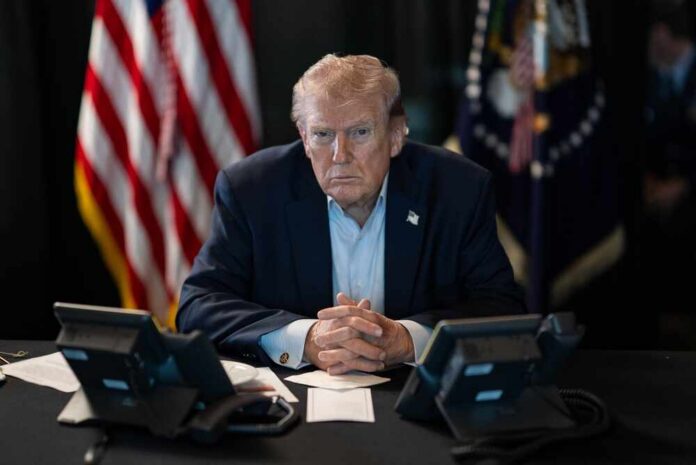
President Trump is telling Americans the Iran war is “very close to being over” even as his administration keeps a naval blockade in place—an unusual mix of peace talk and hard power that has Wall Street watching every move.
See the video below.
Story Snapshot
- President Trump said the U.S.-Iran conflict is nearing an end, while also stressing the U.S. is “not finished” with its objectives.
- A two-week ceasefire is in effect, but the U.S. imposed a naval blockade of Iranian ports, signaling continued leverage.
- Vice President JD Vance led talks with Iranian officials in Pakistan that reportedly produced progress but no breakthrough.
- Markets rose on expectations that renewed talks could reduce geopolitical risk and stabilize energy shipping lanes.
Trump Signals an Endgame While Keeping Maximum Pressure
President Donald Trump told Fox Business that the Iran war is “very close to being over,” framing current events as a near-term transition from fighting to dealmaking.
Trump paired that optimism with a warning that the U.S. is “not finished,” arguing that leaving too quickly would allow Iran to rebuild and potentially restart destabilizing programs. The messaging reflects a familiar Trump approach: talk peace while maintaining leverage.
Trump on Iran war:
I mean, I view it as very close to over. If I pulled up stakes right now, it would take them 20 years to rebuild that country. And we're not finished. We'll see what happens. I think they want to make a deal very badly.
Contributed by @AZ_Intel_. pic.twitter.com/JlWzkQUT0c
— Open Source Intel (@Osint613) April 15, 2026
Vice President JD Vance reinforced that posture after weekend talks in Pakistan with Iranian officials focused on Tehran’s nuclear program.
Reports described the discussions as stalled without a breakthrough, yet Vance said “a lot of progress” had been made and emphasized that “the ball is very much in their court.” For voters tired of endless wars, the key question is whether pressure plus diplomacy can end conflict without rewarding bad behavior.
Ceasefire on Paper, Blockade at Sea
A two-week ceasefire is currently in effect, and the U.S. reportedly agreed to stop bombing Iran the prior week—steps that suggest a controlled de-escalation. On Monday, however, Trump instituted a naval blockade of Iranian ports, intensifying economic and logistical pressure despite the ceasefire framework.
This combination can look contradictory, but it also reflects a classic bargaining strategy: reduce direct strikes while tightening the choke points that matter to a sanctioned economy.
Maritime reality appears more complicated than a headline “blockade” suggests. Separate reporting indicated ships were still managing to cross the Strait of Hormuz, a reminder that enforcement, geography, and international shipping incentives rarely align perfectly in real time.
If transit continues, Iran may retain more commercial oxygen than many Americans assume. If enforcement tightens, energy markets and global trade could feel immediate strain—one reason investors are reacting to every update.
The Nuclear Program Is the Core Issue, Not the Market Rally
Negotiations center on Iran’s nuclear program and enrichment plans, and that is the strategic heart of the conflict. Trump argued that preventing Iran from obtaining nuclear weapons is decisive for regional security, because a nuclear-armed Iran would change the balance of power.
Some reports also referenced disagreements over timelines, including a purported Iranian offer of five years on certain terms, underscoring how “close to over” can still hinge on technical details.
Trump’s comment that Iran would take decades to rebuild if the U.S. “pulled up stakes” is an assertion. Still, the underlying policy debate is clear: how to end hostilities while preventing a rapid return to the same threat environment.
Americans also want clarity on mission scope, costs, and endpoints—especially after years of foreign-policy commitments with unclear measures of success.
Why Wall Street Cares—and Why Voters Should Too
Financial markets posted gains tied to expectations of a peace deal, reflecting a reduced “risk premium” when major conflicts appear to cool. Investors are also watching the Strait of Hormuz because disruptions there can feed directly into energy prices, shipping costs, and inflation—kitchen-table issues that hit retirees and working families first.
New "Politics" post on CNBC: Iran war 'very close to over,' Trump says — and the stock market 'is going to boom' https://t.co/d4UD27UkfP
— Beth Getzelmann💯 (@bethgetz) April 15, 2026
Politically, the episode lands in a familiar place for many Americans: skepticism toward institutions paired with a desire for results. Supporters will see a negotiation backed by strength; critics will see mixed messaging and escalation risk.
Based on the available facts, both interpretations draw from real elements—ceasefire language on one hand, blockade enforcement on the other. The clearest near-term test will be whether the expected Thursday talks produce verifiable nuclear constraints and a durable off-ramp.
Sources:
Trump says Iran war ‘very close to being over,’ peace talks expect resume
Jerusalem Post — Iran news article-893031
In interview excerpt, Trump says Iran war ‘very close to over,’ adds US ‘not finished’