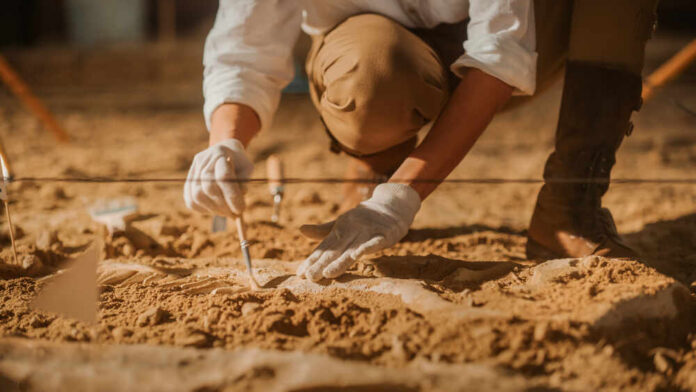
Teams near Mount Ararat just hauled nearly a thousand soil samples and fresh pottery shards from a boat-shaped ridge long tied to Noah’s Ark, and the dig is accelerating.
Story Snapshot
- Researchers expanded excavation and sampling at the Durupınar site near Mount Ararat.
- Pottery fragments spanning Copper Age to Iron Age horizons surfaced around the formation.
- Nearly 1,000 soil cores reportedly went to labs in Ankara for testing.
- Turkish and partner teams said permits and coordinated fieldwork are in place.
Excavation Push Targets A Century-Old Question
Researchers working the Durupınar formation in eastern Turkey advanced a sweeping new round of fieldwork. The team widened the trenching and added core drilling to map the subsurface. Leaders said the effort aims to test whether the outline links to the biblical Ark or to natural geology.
The group reported active permits and a coordinated plan involving universities and technical labs in Turkey. The schedule stacks soil science, artifact recovery, and geophysics into a tight fall-to-winter window.
Field teams flagged two big moves: scaled-up sampling and artifact recovery. Crews collected close to 1,000 soil samples from within and around the boat-shaped ridge. Organizers said the cores traveled to laboratories in Ankara for chemical and microfossil analysis.
The push dwarfs past small-batch studies and sets up a clearer inside-versus-outside comparison across many points. The plan uses perimeter controls and depth slices to track patterns that could point to wood decay or simple erosion.
Pottery Outside The Outline Signals People Were There
Archaeologists reported pottery fragments outside the formation, dated from the Copper Age through the Iron Age. That range, broadly 5500 to 3000 years before present, matches a window of known human activity in the region.
The shards surfaced during road work and follow-up surveys near Doğubayazıt in Ağrı province. The finds do not prove a ship once sat there, but they anchor the site in real human movement and use across long spans of time. That matters for any claim of purposeful construction.
Earlier phases set the stage for this surge. Previous teams gathered dozens of rock and soil samples and reported traces of clay-like materials and marine deposits, including mollusks, dated to about 3,500 to 5,000 years before present.
Those results pushed a new round of drilling and a larger sampling grid to see if the patterns hold across more locations at depth. The new campaign also documents find spots with tighter mapping for later peer review and replication.
Why The Soil Chemistry Matters Now
Soil scientists in this effort want a simple answer to a hard question: does the soil inside the outline behave like a place where organic material rotted in place, or like rock shaped by weather?
If the inside cores show higher carbon, distinct acidity, or ash-linked minerals in a pattern that stops at the ridge edge, that clue is worth testing again. If not, the ridge likely reflects normal sediment layers. Large control sets and stratified cores help end the guessing and the hype.
🔥🔥 Noah's Ark 🔥🔥
After 70 years, Researchers with @noahsarkscans have secured permits and begun core drilling at the Durupinar site near Mount Ararat in eastern Turkey.
Genesis 8:4: "And the ark rested in the seventh month, on the seventeenth day of the month, upon the… pic.twitter.com/tagKOCgrbi
— KJofTikTok (@TheKJofTikTok) September 23, 2026
Permits and oversight reduce the risk of sampling bias. Project leaders pointed to formal approvals from Turkish agencies and collaboration with local universities. Those steps matter because they tie field methods to standard archaeological practice, chain-of-custody rules, and domestic stewardship.
The process also improves access to national labs for dating, pollen, and microfossil testing. That is the path that can turn a headline into a dataset others can check and either confirm or refute on the merits.
The public cares about the Ark because it mixes faith, family lore, and deep history. This project respects that interest but moves on facts. Pottery outside the ridge proves people used the area; it does not, by itself, tie the ridge to a ship.
Nearly a thousand cores create a chance to settle what smaller studies could not. If results show strong, bounded chemical signals, expect calls for cautious excavation. If the signals wash out, the claim should step aside until better evidence emerges.
Sources:
metro.co.uk, dailymail.com, jpost.com, noahsarkscans.com, x.com