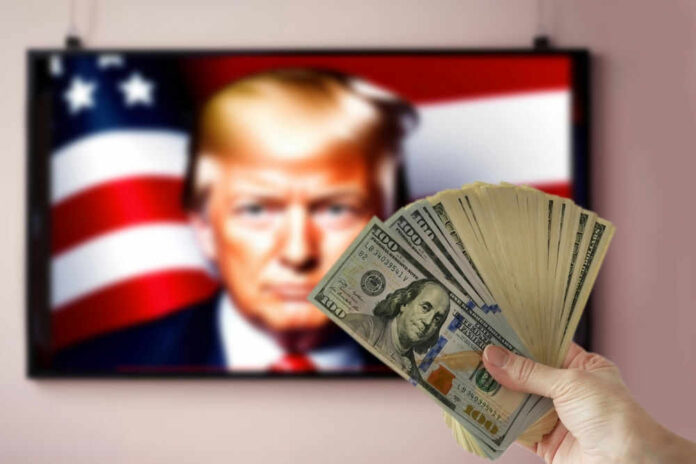
President Trump’s tariff policy could lead to $2,000 dividends for Americans, stirring both excitement and debate about fiscal responsibility and government intervention.
Story Highlights
- Trump proposes up to $2,000 in dividends from tariff revenue.
- Supreme Court to rule on the legality of Trump’s global tariffs.
- Tariff revenue might support both deficit reduction and farmer aid.
- Congressional approval is needed for any disbursement to citizens.
Trump’s Tariff Proposal: A Bold Economic Strategy
President Trump has announced a plan to potentially distribute up to $2,000 in dividends to Americans, funded by revenue from global tariffs. This initiative aims to capitalize on the significant income generated by these tariffs, which Trump claims are sufficient to halve the U.S. deficit.
Such a move underscores a strategic shift towards leveraging trade policies to directly benefit U.S. citizens, aligning with conservative values of economic self-reliance and fiscal responsibility.
Trump’s tariff strategy has been a cornerstone of his administration’s economic agenda. However, it faces a critical juncture as the Supreme Court prepares to hear arguments on November 5 regarding its legality.
A previous court ruling suggested Trump may have exceeded his authority in imposing these tariffs, designed initially as emergency measures. The outcome of this case will not only impact Trump’s ability to sustain these tariffs but also determine the feasibility of his proposed dividends.
Dividends: A New Frontier in Fiscal Policy
The idea of returning tariff revenue to the American public was initially proposed by businessman James Fishback, who suggested that 20% of savings identified by Elon Musk’s Department of Government Efficiency (DOGE) could be redistributed.
Although House Speaker Mike Johnson has shown reluctance towards the proposal, Trump’s consideration of this idea reflects a novel approach to fiscal policy, potentially setting a precedent for future government disbursements.
For this initiative to move forward, it would require congressional approval, posing a political hurdle that could test the administration’s ability to navigate legislative processes.
This proposal not only raises questions about economic fairness and government spending but also highlights the ongoing debate over how best to utilize government revenues to benefit the broader population.
Implications for Farmers and Trade Policy
In addition to potential dividends, Trump has indicated plans to use tariff revenues to support U.S. soybean farmers affected by the U.S.-China trade conflict.
By allocating a portion of tariff income to aid these farmers, the administration aims to mitigate the economic impact of China’s reduced purchases, a strategy that aligns with supporting domestic agricultural industries while addressing global trade dynamics.
This multifaceted approach to utilizing tariff revenue illustrates a broader economic strategy that seeks to balance immediate financial relief for citizens with long-term support for critical sectors.
It remains to be seen how these proposals will unfold amidst legal challenges and political negotiations, but they represent a significant shift in how trade policy can be leveraged for domestic benefit.