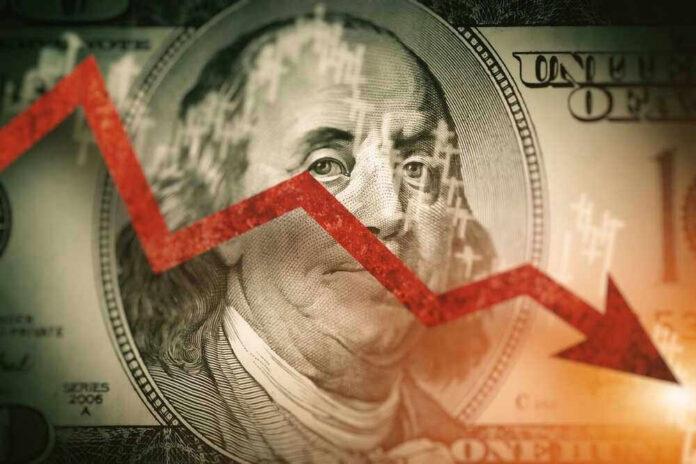
Wall Street traders now see a 35% chance of recession by year’s end, as unemployment trends pierce a key historical threshold that has signaled every downturn since 1950—raising alarms that war costs and tariffs could finally break America’s economic back.
Story Snapshot
- Albert Edwards’ chart shows U.S. unemployment breaking its three-year moving average, a pattern that has preceded all eight recessions since 1950.
- Despite strong GDP and consumer spending, labor market softening echoes past downturns amid war spending and tariff-driven inflation.
- MAGA families face higher energy bills from Iran conflict while questioning endless wars that betray promises of America First peace.
- Markets price in 35% odds of a recession by end-2026, clashing with optimistic forecasts of 2.2% growth.
Historical Warning Signals Reactivate
Société Générale strategist Albert Edwards highlights a chart where the U.S. unemployment rate breaks above its three-year moving average. This pattern has preceded every recession since 1950, with eight instances that perfectly match downturns.
November 2025 unemployment hit 4.6%, signaling sluggish hiring and job openings. Edwards calls the recession the biggest threat to equities, urging caution despite recent resilience.
Conservative families, already strained by high energy costs from the Iran war, watch war spending divert funds from domestic priorities like border security and debt reduction.
Goldman Sachs just raised US recession odds to 30%, the third bump in 90 days.
Growth is slipping below potential, oil is stuck around crisis levels, and credit is tightening into a weakening jobs market.
This is what the start of a recession actually looks like in real time.…
— StockMarket.News (@_Investinq) March 24, 2026
Labor Paradox in War Economy
Unemployment remains stable at 4.6%, with a misery index of 7.3% outperforming 76% of 50-year historical benchmarks. Yet hiring rates and openings lag pandemic peaks, creating tension.
The Sahm Rule triggered a false positive in August 2024, eroding trust in short-term indicators. Edwards’ longer three-year view persists amid structural shifts such as labor shortages and policy volatility stemming from tariffs.
Trump supporters, who promised no new wars, now grapple with fiscal burdens as supplemental funding tops $25 billion for Iran operations, fueling inflation fears.
Conflicting Forecasts Divide Experts
J.P. Morgan sees no real recession threat, projecting 2.2% GDP growth for 2026 and two Fed rate cuts. Goldman Sachs forecasts sturdier 2.8% global growth with 50 basis points of cuts. Inflation may hit 3.6% by June due to tariffs and stimulus, then ease to 2.2%. Consumer spending holds strong despite weak sentiment.
Polymarket traders assign a 35% probability of a recession by end-2026, balancing bearish warnings against mainstream optimism. Everyday Americans, hit by $3.98 gas amid war escalation, demand fiscal discipline over global entanglements.
Federal Reserve rate cuts signal confidence, but tariff effects and war costs introduce uncertainty. Growth could slip to 1.7% in 2027 without more stimulus. Lower-wage workers in cyclical industries face outsized risks if labor weakens further.
Recession odds climb on Wall Street as economy shows cracks beneath the surface. The economy last year lost more than half a million jobs excluding health care. https://t.co/EtRBaEwfsx
— Jeff Cox (@JeffCoxCNBCcom) March 25, 2026
Impacts on Families and Markets
Equity markets price resilience, but a recession would hammer stocks, especially tech growth names. Cyclical sectors like manufacturing and retail suffer most, while healthcare and utilities offer defense.
Workers in construction face job losses; investors see downside in equities but gains in bonds from cuts. Consumers risk reduced spending power.
For Trump loyalists frustrated by past globalism and overspending, current war outlays echo the pitfalls of regime change, eroding promises of limited government and no foreign adventures. Policy choices now dictate if historical patterns repeat.
Sources:
Business Insider: “One Chart Shows Why a Recession Could Still Be in the Cards in 2026”
Polymarket: US Recession by End of 2026
J.P. Morgan Asset Management: A Baseline Forecast for 2026
Stanford SIEPR: US Economy 2026: What to Watch