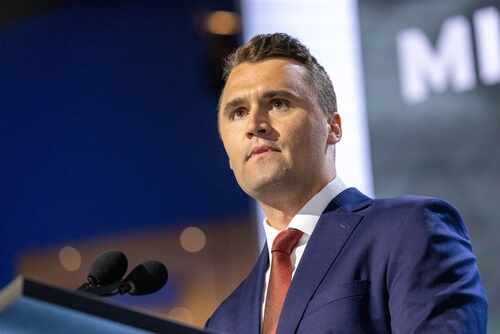
Arizona’s governor just vetoed a bill to honor the late Charlie Kirk, turning what should have been a straightforward memorial into another partisan battle over who gets remembered—and who gets erased.
Quick Take
- Gov. Katie Hobbs vetoed legislation that would have renamed Loop 202 in the Phoenix area as “Charlie Kirk Loop 202.”
- Republican lawmakers say the veto politicizes a long-standing tradition of honoring influential Arizonans, regardless of party.
- Hobbs argued the bill improperly bypassed Arizona’s standard, nonpartisan naming process handled by a state board.
- The fight follows an earlier Hobbs veto of a Charlie Kirk specialty license plate tied to Turning Point USA funding.
Hobbs blocks Loop 202 rename after GOP bill clears Legislature
Governor Katie Hobbs, a Democrat, vetoed a measure on March 27 that would have renamed Loop 202—a 78-mile beltway around the Phoenix area in Maricopa County—after conservative activist Charlie Kirk.
Kirk, an Arizona-based political organizer and founder of Turning Point USA, was assassinated in 2025 during an event at Utah Valley University. Republican lawmakers advanced the bill through the GOP-controlled Legislature largely along party lines before it reached Hobbs’ desk.
JUST IN: Gov. Katie Hobbs has vetoed a bill that aimed to rename Loop 202 after Charlie Kirk. https://t.co/K2x5inEvoq pic.twitter.com/yRsRMIroYG
— ABC15 Arizona (@abc15) March 28, 2026
Hobbs said her objection centered on the process rather than the tragedy of Kirk’s death. In her veto message, she condemned the assassination as “tragic and horrifying,” while arguing the bill injected politics into a government function that should remain nonpartisan.
Her administration pointed to the Arizona State Board of Geographic and Historic Names as the customary channel for such decisions, emphasizing that the board exists to provide a consistent process across administrations and election cycles.
Process dispute: Legislature’s bill bypassed the state naming board
Reporting on the bill highlighted a key procedural issue: the legislation did not simply request consideration of a new name. It required the state to adopt the “Charlie Kirk Loop 202” designation and directed the Arizona Department of Transportation to install related signage, effectively bypassing the Arizona State Board of Geographic and Historic Names.
That design choice made the debate less about whether Kirk should be honored and more about whether lawmakers should sidestep a standing naming system when a political moment demands speed.
Republican Senate President Warren Petersen, who sponsored the bill, argued that the veto itself turned the issue into politics. Petersen said Arizona has a tradition of honoring individuals who made an impact, and he criticized the idea that recognition should depend on whether the honoree aligns with the sitting governor’s politics.
In public statements, he framed Hobbs’ decision as a departure from a standard in which memorials are not treated as campaign talking points—or veto targets.
Ed Pastor precedent becomes a flashpoint in the “politicization” argument
Supporters of the bill pointed to a recent precedent: a segment of Loop 202 was named in 2019 for Ed Pastor, a Democrat and Arizona’s first Mexican-American member of Congress, who died in 2018.
That designation was handled through the usual process and has been used by Republicans to argue that honoring public figures should not be a partisan privilege. Critics of the Kirk bill responded that the comparison breaks down because the Kirk measure explicitly avoided the normal review track.
Hobbs’ veto message did not cite Kirk’s controversial past statements, even though some coverage noted disputes over his views on issues including LGBTQ+ policy, abortion, and the Civil Rights Act.
The governor instead kept her reasoning narrow: highway naming should run through a nonpartisan mechanism. For voters tired of ideological warfare seeping into every public institution, Hobbs’ approach presents a clear standard—though it also invites the question of why the Legislature felt the board process was insufficient for this particular figure.
Second veto this month: specialty plate plan for Turning Point USA funding
The highway dispute comes after Hobbs vetoed a separate bill earlier in March to create a Charlie Kirk specialty license plate, with proceeds tied to a Turning Point USA-related charitable effort run after Kirk’s death.
Taken together, the two vetoes send a consistent message from the governor’s office: state-backed recognition and state-enabled fundraising are areas where Hobbs is unwilling to grant special legislative carve-outs. Republicans see the pattern as a deliberate refusal to honor a prominent conservative voice.
What happens next, and why it matters beyond a road sign
As of the latest reports, no override attempt had been announced following the March 27 veto. Practically, Phoenix-area drivers will see no immediate change, and Arizona avoids the cost of new signage.
Politically, the clash lands in a divided-state reality: a Democrat governor facing reelection pressure and a Republican Legislature trying to reflect its voters’ priorities.
The larger takeaway is procedural power—whether memorial naming runs through a neutral board or becomes a legislative weapon whenever one party wants to force a fast outcome.
The dispute also has national echoes. Coverage noted similar legislation in Florida involving “Charlie Kirk Memorial Avenue” and “President Donald J. Trump Boulevard,” with Governor Ron DeSantis not yet acting on those measures.
That comparison underscores why process fights matter: once a state starts treating naming as a partisan contest, every future memorial becomes a proxy war.
Sources:
Charlie Kirk highway got vetoed in Arizona. Elected officials are citing politics.
AP US Charlie Kirk highway 1st ld writethru
Arizona Gov. Hobbs vetoes highway name change for Charlie Kirk
Arizona Gov. Hobbs vetoes highway name change for Charlie Kirk