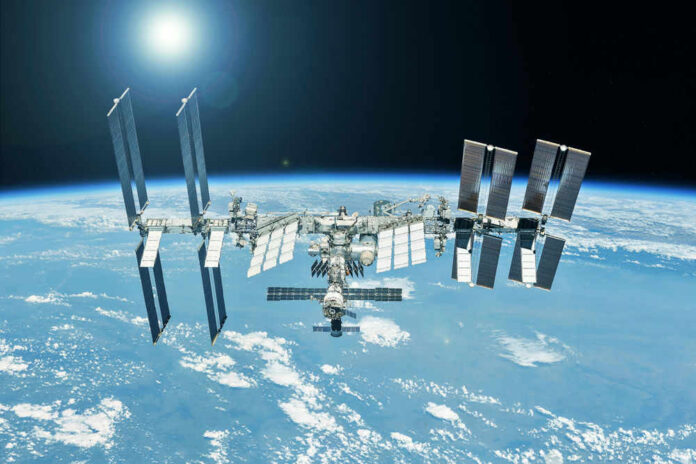
A massive 1,300-pound NASA satellite is plummeting uncontrolled toward Earth.
Story Snapshot
- Van Allen Probe A, weighing 1,323 pounds, is set for fiery re-entry on March 10, 2026, after 14 years in orbit, with low public risk but potential surviving debris.
- Solar activity from the 2024 peak accelerated decay, pulling the fuel-depleted satellite down years ahead of 2034 projections.
- U.S. Space Force and NASA monitor the event, emphasizing the value of data for protecting power grids and communications from space weather.
- Historical precedents show no public injuries from similar re-entries, thanks to 70% ocean coverage, which reduces ground risk to 1 in 4,200.
Mission Background and Uncontrolled Descent
NASA launched the Van Allen Probes, A and B, in August 2012 to study the Van Allen radiation belts, rings of charged particles trapped by Earth’s magnetic field.
These belts shield against cosmic radiation, solar storms, and solar wind that threaten humans, satellites, power grids, and communications.
Designed for a two-year mission, operations extended through 2014 due to strong performance but ended in 2019 when fuel ran out, resulting in the loss of sun-pointing capability. Without propulsion, the satellite entered uncontrolled decay.
1,300-pound NASA satellite re-enters Earth's atmosphere after 14 years in space. https://t.co/TeFeARe9z1
— CBS News (@CBSNews) March 11, 2026
Solar Cycle Accelerates Orbital Demise
Solar cycle 25 peaked in 2024, expanding the upper atmosphere and increasing atmospheric drag on low-Earth-orbit objects. This natural phenomenon pulled Probe A down faster than the original 2034 projection, shifting predictions to early 2026.
Twin Probe B remains in orbit until around 2030, providing a comparison for decay models. NASA noted the current solar cycle proved more active than expected, highlighting space weather’s unpredictable impact on aging satellites lacking modern propulsion systems.
Re-Entry Timeline and Risk Assessment
On March 9, 2026, NASA issued a statement predicting re-entry around 7:45 p.m. ET on March 10, plus or minus 24 hours. The U.S. Space Force tracked the descent via Space-Track and issued aviation and maritime notifications as needed.
Most of the spacecraft burns up during re-entry, with some components potentially surviving to reach the surface. The risk to people stands at 1 in 4,200, or 0.02%, primarily because 70% of Earth’s surface is water, which favors ocean impacts.
Stakeholders, Precedents, and Broader Implications
NASA manages scientific legacy and public communications, while the U.S. Space Force ensures national security through tracking and collision avoidance. Scientists continue to analyze archived data to improve space-weather forecasting for satellites, astronauts, and infrastructure.
Past uncontrolled re-entries, such as NASA’s UARS in 2011, with 26 surviving debris pieces, and ESA’s ERS-2 in 2024, have recorded no public injuries.
This event underscores the need for improved debris mitigation amid rising numbers of satellites, reinforcing U.S. leadership in space traffic management without sparking taxpayer panic over negligible threats.
Short-term effects remain minimal, with monitoring preventing disruptions. In the long term, the mission’s radiation belt insights protect critical sectors such as communications and power grids from solar disruptions. Economically, no damage is expected; socially, it boosts awareness of orbital risks without sensationalism.
Under President Trump’s administration, efficient agencies like Space Force demonstrate strong stewardship of American space assets, prioritizing safety and innovation over wasteful globalist programs.
Sources:
1,300-Pound NASA Satellite To Fall From Orbit, Re-Enter Earth’s Atmosphere
1,300-Pound NASA Satellite To Fall From Orbit, Re-Enter Earth’s Atmosphere
1300-pound satellite expected to enter Earth’s atmosphere tonight
NASA satellite set for fiery Earth reentry Tuesday
NASA satellite crash alert: 1300-pound spacecraft set for fiery reentry