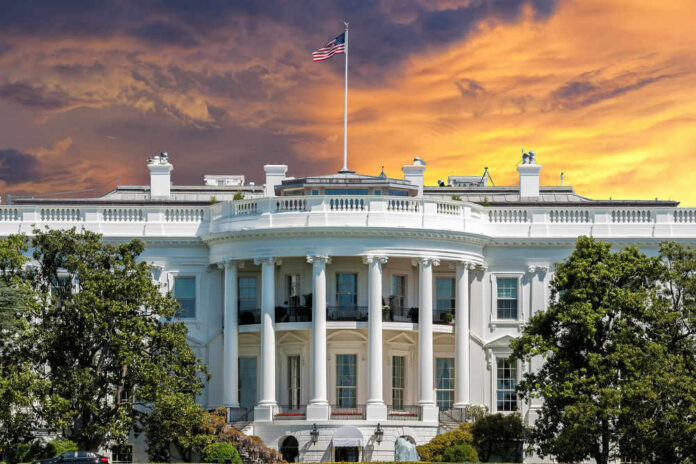
President Trump revealed plans for a massive underground military complex beneath a new White House ballroom, marking a bold transformation of the nation’s most famous residence into a fortified command center for modern threats.
See the video below.
Story Highlights
- Trump disclosed plans for a military-built underground complex beneath a new $400 million White House ballroom during an Air Force One briefing
- The 90,000 square foot ballroom serves as a protective “shed” over the facility, featuring bulletproof glass and drone-proof design
- Preservationists challenged the project in court, arguing it bypasses congressional approval, but Judge Richard Leon denied their injunction
- The privately-funded project replaces the demolished East Wing and is scheduled for completion in 2028, ahead of the original timeline
Trump Unveils Dual-Purpose White House Expansion
President Donald Trump shared detailed renderings aboard Air Force One on March 29-30, 2026, revealing the military’s construction of a massive underground complex beneath a planned White House ballroom.
The president described the ballroom as essentially a “shed” covering the military facility below, designed to protect against modern threats including drone attacks.
Trump emphasized the project is ahead of schedule, with the military driving construction that he said they “wanted more than anybody.” The disclosure marks the first public confirmation of the facility’s dual purpose since the ballroom’s announcement in July 2025.
BELOW THE SURFACE: President Trump reveals the U.S. military is building a "massive complex" beneath the planned, privately-funded White House ballroom, and that construction is "ahead of schedule." pic.twitter.com/VDbepFqox8
— Fox News (@FoxNews) March 30, 2026
Private Funding Shields Project From Taxpayer Burden
The $400 million construction relies entirely on private donations, sparing taxpayers from funding the ambitious White House transformation. The new ballroom will span 90,000 square feet with capacity for 650 to 1,000 people, addressing longstanding needs for larger event spaces, including inaugural celebrations.
Trump ordered the demolition of the historic East Wing in October 2025 to clear the site, removing offices that housed first lady staff and the Presidential Emergency Operations Center bunker built under Franklin D. Roosevelt. White House Press Secretary Karoline Leavitt confirmed military “upgrades” on March 30 but declined to provide specific details about the underground complex.
Preservationists Challenge Rapid Construction Timeline
The National Trust for Historic Preservation filed legal challenges demanding congressional approval and public comment before proceeding with construction on the historic White House grounds. The organization accused the Department of Justice of “fishing for justification” in court filings that emphasized security necessities.
Judge Richard Leon denied the preservationists’ request for an injunction, allowing work to continue despite ongoing legal disputes. Architects noted the unusually fast timeline for construction on a historic site, particularly given the project’s complexity and security implications.
The Commission of Fine Arts, led by Trump allies, granted early approval before the National Capital Planning Commission’s final vote scheduled for March 31, 2026.
Modern Security Demands Drive Underground Fortification
Trump emphasized the facility’s design addresses threats in the “modern age,” specifically highlighting protection against drones alongside bulletproof glass features. The military’s direct involvement in construction ensures secure execution of classified elements within the underground complex.
The Department of Justice defended the project in court filings by stressing security necessities, though independent confirmation of construction details remains limited. The ballroom’s 2028 opening will transform White House capabilities for both public events and national security operations.
This privately-funded model sets precedent for future federal construction projects while avoiding the fiscal mismanagement and government overspending that conservatives have long criticized in previous administrations.
The project represents a significant legacy initiative for Trump’s second term, combining enhanced security infrastructure with expanded event hosting capabilities.
The transformation of the East Wing site into a fortified complex demonstrates commitment to protecting America’s seat of power against evolving threats while maintaining the White House’s role as the nation’s premier venue for state functions and celebrations.
Sources:
Trump details plans for ‘massive’ military complex under new WH ballroom – Straight Arrow News
Trump says military building massive complex beneath new White House ballroom – Fox5DC