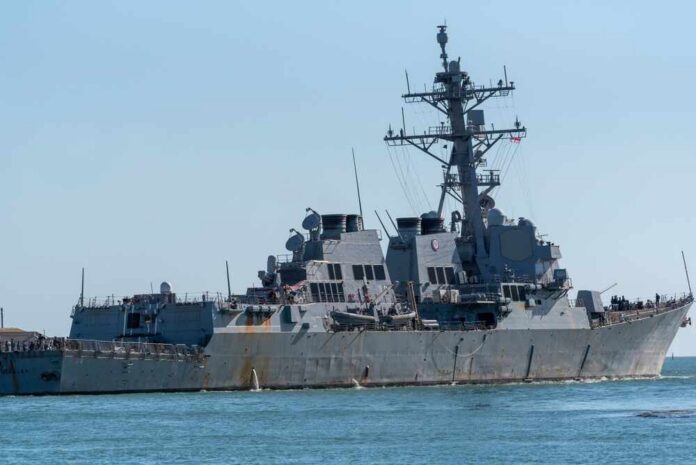
An American warship sat dead in the water for four straight days in one of the most contested seas on earth, with no engines, no air conditioning and no working toilets.
Quick Take
- USS Benfold lost all power on July 24 after an engineering failure tied to its generators, the Navy confirmed.
- Sailors went four days without air conditioning, potable water, galley service and working toilets in the South China Sea.
- No crew members were hurt, and the destroyer was towed to Subic Bay in the Philippines for repairs.
- The incident is the second Navy power failure in the Indo-Pacific this year, following a similar case aboard USS Higgins in May.
A Guided-Missile Destroyer Goes Dark
The USS Benfold, an Arleigh Burke-class guided-missile destroyer, was sailing with the USS George Washington Carrier Strike Group when its power failed on July 24.
Seventh Fleet spokesman Commander Matthew Comer said the ship suffered an “engineering casualty” involving its generators, which knocked out power fleet-wide aboard the vessel. The destroyer could not move under its own power for four days while crews worked to restore it.
A power outage aboard a U.S. Navy destroyer in the South China Sea last month deprived the crew of drinking water, hot meals, functioning toilets and air conditioning for four days. pic.twitter.com/ZEEptraDl5
— Breaking911 (@Breaking911) August 19, 2026
Losing generator power on a warship does not just mean the lights go out. It means the engines stop, the radar goes quiet, and the ship becomes a floating target with no way to defend itself or maneuver.
For four days, roughly 300 sailors rode out that reality in the South China Sea, a stretch of water where Chinese naval and coast guard vessels operate constantly and tensions run high.
Four Days Without Basic Necessities
With generators down, the Benfold lost air conditioning, potable water, galley services and working toilets, according to Navy officials. Sailors endured the heat with no working restrooms and limited food, relying partly on supplies brought by other ships in the strike group.
Comer said the crew “demonstrated resilience, grit, professionalism and unwavering steadiness” throughout the ordeal, and the Navy confirmed no one was injured.
Once power could not be restored at sea, the Navy towed the Benfold to Subic Bay in the Philippines, where repair crews completed the fix in August. The Navy has not yet announced a root cause.
“Engineering casualty” is a broad Navy term covering everything from worn-out parts to wiring failures, and officials say the investigation into what specifically failed aboard the Benfold is still ongoing.
Not an Isolated Incident
The Benfold breakdown was the second Indo-Pacific power failure involving a Navy destroyer this year. In May, the USS Higgins lost power and propulsion for several hours after an electrical fire disabled its system, a separate but similar “engineering casualty.”
Two major power failures on front-line destroyers in the same region within a few months is not the kind of coincidence that should get waved away as bad luck.
What This Says About Fleet Readiness
Arleigh Burke-class destroyers form the backbone of the Navy’s surface fleet, and they are aging under a brutal deployment schedule. A 2020 Pentagon inspector general audit found that engineering casualties on this destroyer class have previously caused sailor deaths and serious damage, not just inconvenience.
The Congressional Budget Office has separately warned that these destroyers will spend up to 27 percent of their planned service lives tied up in overhauls and maintenance, a sign the fleet is stretched thin.
That combination, older ships, packed deployment schedules, and maintenance backlogs, creates exactly the conditions where generator failures become more likely, not less.
Taxpayers have poured enormous sums into naval readiness, and sailors deserve equipment that does not leave them defenseless off China’s coast for four days.
The Navy owes Congress and the public a clear account of why this kept happening twice in one year, and what fixes are actually funded rather than just promised.
For now, the Benfold is repaired and presumably back in service, and no sailors were hurt during the ordeal. But the episode is a blunt reminder that naval power depends on unglamorous machinery working exactly when it is needed most, especially in waters where an American warship cannot afford to be a sitting target, even for an hour, let alone four days.
After a complete loss of power on the USS Benfold, sailors on board went four days with limited drinking water, and no working toilets or air conditioning.
https://t.co/S1qbQP6gpU— Central Oregon Daily News (@CODaily) August 19, 2026
Expect lawmakers overseeing military readiness to press the Navy for answers once the investigation into the Benfold’s generators wraps up. Given the stakes in the South China Sea, that answer needs to come with a plan, not just a report.
Sources:
cbsnews.com, stripes.com, cnn.com, usni.org, linkedin.com, timesofindia.indiatimes.com