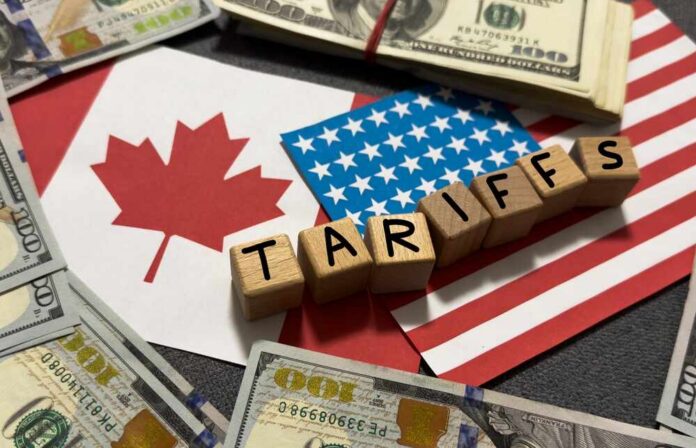
Canada switched on 25 percent tariffs against a first $30 billion in U.S. goods at 12:01 a.m., and it did not blink.
Story Snapshot
- Canada imposed 25 percent tariffs on a first tranche of U.S. imports starting March 4, 2025.
- The official list names perfumes and toilet waters; more goods followed in phases.
- Ottawa said the tariffs stay until the United States removes its measures.
- United States farm analysts confirmed the rollout and scale of the response.
Canada’s Line in the Sand: What Changed at the Border
Canada imposed 25 percent tariffs on a targeted list of U.S. goods effective March 4, 2025. The Department of Finance Canada set the start time at 12:01 a.m. and framed the move as a direct response to U.S. trade actions.
The package launched with about $30 billion in imports and sat inside a larger plan reaching $155 billion if needed. Ottawa said the tariffs would remain until the United States removed its measures against Canadian products.
The initial tariff list spelled out specific products. It included perfumes and toilet waters under the harmonized system code 3303. Canada posted the list and the effective date on the same day. The message was clear: this was not a threat on paper, it was policy at the port.
Reuters reported that Prime Minister Mark Carney tied the timing to U.S. moves and said the countermeasures begin Tuesday and persist until Washington backs off.
How the Retaliation Rolled Out in Phases
Canada structured the response in waves. The first wave began March 4. A second wave followed on March 13, with another C$29.8 billion in imports entering the tariff net, according to contemporaneous reporting.
This cadence showed a strategy: act, watch, then widen. The phase-in kept pressure on Washington while giving Ottawa room to add or adjust lines based on feedback and leverage needs.
United States agriculture officials tracked the rollout as well. The Foreign Agricultural Service summarized that Canada implemented a 25 percent tariff on an initial tranche of more than $20 billion in U.S. goods on March 4.
That independent note mattered for farmers, grocers, and shippers planning loads, pricing, and shelf space. The cross-border food trade is sensitive to even small frictions; a 25 percent jump can flip a shipment from viable to stranded.
Canada's counter-tariffs take effect on US products as trade war heats up.
Duties of 15%, 25% and 50% apply to $27.6 billion (US$20 billion) in imports from the United States, covering steel and aluminum products as well as dairy goods like cheese https://t.co/HmYIxh0p7o pic.twitter.com/olSk2fEG1y
— AFP News Agency (@AFP) September 8, 2026
What’s in the Basket, and Why These Goods
Governments choose tariff targets to sting without self-harm. Canada’s list reached into consumer items that get noticed. Beauty products were on the sheet from day one, with perfumes and toilet waters listed by code.
Later summaries described expansions that touched dairy and golf equipment at higher rates, underscoring how the basket can evolve as pressure points shift. The selection aims to hit visible brands and swing-state producers while keeping core inputs flowing at home.
BREAKING REPORT: Canada IMPOSES retaliatory tariffs of up to 50% on multiple goods.
Canada's tariffs range from 15% to 50%.
American milk, perfume, video game consoles, golf clubs, fishing rods, steel, aluminum, jackets and T-shirts will face 50% tariffs.
Cheese, carpets…
— Chuck Callesto (@ChuckCallesto) September 8, 2026
Ottawa’s logic echoed a standard playbook. Retaliation signals resolve and seeks to move negotiations. Economists warn that tit-for-tat raises prices, saps confidence, and weighs on output when both sides dig in.
Political leaders still reach for tariffs because they are fast, blunt, and legible to voters. The gains can be short, but the costs tend to linger, especially for families who see higher prices in the aisle and small firms that live on thin margins.
What It Means for Households, Stores, and Common Sense
Consumers feel tariffs as price hikes or empty shelves. A 25 percent tariff on a finished good is hard to hide. Retailers can swallow some cost for a while, but not for long. Importers may rush to find non-U.S. supply, yet switching takes time and cash.
From a common-sense view, stable trade with neighbors beats a see-saw of fees and exceptions. America and Canada build things together. When one side taxes the other, both supply chains creak and jobs wobble.
For U.S. producers, the signal is simple: plan for friction until Washington and Ottawa reset the terms. For Canadian buyers, the plan is to diversify supply where it pencils out, and push for relief where it does not. The path out is also familiar.
De-escalation starts when one side removes a plank and the other matches it. Canada said as much on day one: lift your tariffs and we lift ours. Until then, perfume at the counter and other targeted goods will tell the story at the register.
Sources:
cbsnews.com, reuters.com, halifax.citynews.ca, canada.ca, ey.com, fas.usda.gov