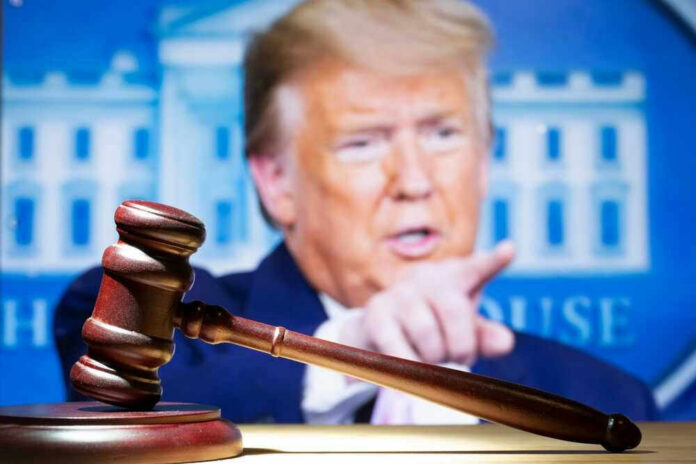
A federal judge shut the door on moving President Trump’s hush money case to federal court, and the why matters more than the no.
Story Snapshot
- Judge Alvin Hellerstein said the case was about private acts, not official duties.
- The court found Trump’s new removal push came too late and lacked good cause.
- A federal appeals court had reopened the question, but it did not change the result.
- Trump’s team tied removal to presidential-immunity arguments and White House talks.
What the judge decided and why it sticks
Judge Alvin Hellerstein rejected President Trump’s latest bid to move his New York hush money case to federal court. He wrote that the payments were a “purely personal item” and not tied to presidential duties.
He stated, “Hush money paid to an adult film star is not related to a President’s official acts,” which set the tone for the outcome. That framing kept the case in state court and blocked a federal judge and jury from taking over the record after a state verdict.
A judge has again rejected Trump’s bid to erase his hush‑money conviction, calling his renewed arguments legally insufficient. https://t.co/UjYFwAmcfs
— Newsweek (@Newsweek) August 28, 2026
The judge also found Trump had not shown good cause or diligence to justify removal at this stage. He called the renewed arguments “neither new nor legally sufficient,” signaling that timing and content both fell short. Courts usually treat removal as a front-end question.
Once a state case moves through trial, judges guard finality. That instinct is stronger when the facts look personal and local, not tied to federal duties.
The defense theory and its federal hook
Trump’s lawyers argued the case touched official acts because it included White House conversations and office-related context. They linked that to the Supreme Court’s presidential-immunity ruling, saying it supplied a new legal hook for federal treatment.
The team claimed some evidence belonged in a federal forum to sort out official versus private acts. That pitch aimed to reframe the case as constitutional and institutional, not just about bookkeeping around a payoff.
The record, however, did not persuade the judge that the charged falsification crimes arose from duties of the office. The Manhattan district attorney pressed the point that the conduct was “wholly private, unofficial,” and the court agreed with that view.
Without a tight link to official acts, the federal-officer removal path narrows. The court’s line was clear: personal cover-ups are not policy, and White House chatter does not convert private acts into federal business.
The timing trap that shaped the outcome
Procedure carried as much weight as substance. Removal fights usually happen before trial, not after conviction and sentencing. The appeals court sent the issue back for another look, giving Trump a small window.
But the judge found no statutory basis to uproot a finished state case and treat federal court like an appeals stop. Prosecutors argued that point in open court: removal decides the trial forum, not a post-sentencing transfer for review. The judge’s ruling tracked that logic.
In this case, rules must be clear and stable. A late switch invites forum shopping and endless delay. If removal after verdict were easy, every state prosecution of a federal officer could become a backdoor to a new trial.
That would undercut state authority and finality. The better path is to raise removal fast, tie it to office duties, and show a real federal defense. Trump’s team did not clear that bar here.
What this means for future fights
Expect more battles over where to try cases that touch the Oval Office. The law allows removal when a federal officer faces charges for acts under color of office and has a federal defense. But courts will require a direct link between the charged conduct and the job, as well as timely action.
The Second Circuit’s remand showed judges will entertain the question, but the door narrows if the facts look private and the clock has run. Procedure is policy in this lane.
The takeaway is simple but sharp. Jurisdiction follows function, and timing is a test of fairness. If a defendant wants a federal forum, the record must show acts of office, not personal cleanup.
And the request must come before the die is cast. The judge drew that line and held it. That is the kind of guardrail that keeps hard cases from rewriting the rules in the heat of the moment.
Sources:
abcnews.com, cnbc.com, aljazeera.com, washingtonpost.com, bbc.com, bloomberg.com, courthousenews.com