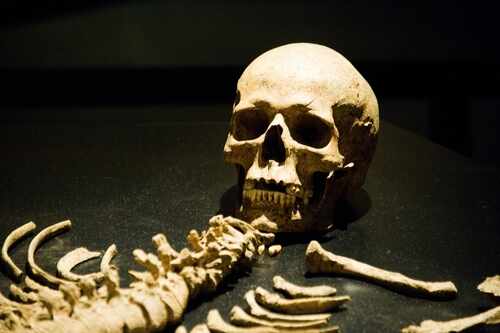
After ninety years in the dark under a Toronto garage floor, a murdered woman finally has her name back: Mary McLeod Moffat.
Story Snapshot
- A woman killed in 1936 and buried under a garage was identified in 2026 as Mary McLeod Moffat.
- Her remains were found by demolition workers in 1995 at a Danforth Avenue automotive shop.
- Toronto police used DNA and genetic genealogy to trace her family and confirm her identity.
- Investigators now believe her husband killed her around April 1936 and secretly buried her body.
A hidden grave beneath an ordinary Toronto building
Demolition workers in May 1995 thought they were just tearing down an old automotive garage on Danforth Avenue, east of downtown Toronto.
Under the concrete floor at 1515 Danforth, they hit soil instead of more foundation. Buried in that soil were human bones.
Forensic experts soon confirmed the remains belonged to a woman in her twenties who had suffered at least six blows to the head from a hammer-like weapon. Someone did not just hide a body there. Someone made sure that body would never be found.
Woman murdered in 1936 and buried underneath building is finally identified: "One of Toronto's oldest mysteries" https://t.co/G1fbB2nQXG
— CBS Mornings (@CBSMornings) July 28, 2026
Police believed from the start that they were looking at a homicide from decades earlier, not a recent killing. The building dated back to the 1930s. The depth of the burial and the state of the bones suggested the woman had been put there long before modern Toronto grew up around her.
Yet no missing person report, no name, and no family story seemed to match. Through the late 1990s and 2000s, investigators chased leads, checked old records, and compared dental and bone details. The case stayed cold. The woman became another “Jane Doe,” known only as a victim in an old crime with no voice.
From anonymous bones to a full life story
In 2022, Toronto Police Service turned to a new tool that has changed cold cases across North America: investigative genetic genealogy. Detectives sent a sample from the woman’s bones to Othram, a specialized forensic DNA lab in Texas, to build a stronger DNA profile than older methods could give.
The lab used advanced sequencing to read far more of her genetic code than routine testing allows. That profile was then compared to people in genealogy databases who had shared their DNA for family history, looking for distant relatives who might connect back to the unknown victim.
Othram’s scientists and Toronto police genealogists developed leads to possible family lines and then used targeted testing of a potential relative. A rapid comparison confirmed that the bones under the garage belonged to a woman named Mary McLeod Moffat, born Mary Davidson.
She was born in Aberdeenshire, Scotland, in 1905 and immigrated to Canada with her family in 1913. Police and genealogists did not stop at a name. They rebuilt her life from records: she married in Toronto, had a son, and lived an ordinary, respectable life by the standards of that era, until she vanished.
A 1936 marriage turned deadly behind closed doors
Historical records and interviews with surviving relatives showed a darker side behind the polite public face of Mary’s marriage. Investigators concluded she was likely killed around April 1936, during a confrontation with her husband. Toronto police now suspect that husband, Andrew Lloyd Moffat, murdered her and buried her under the garage floor.
He later moved on, living in the United States and Vancouver under the alias Drake Lloyd Cummings, and he died in 1985 without ever facing justice.
Police say evidence from the burial site supports that this was not an accident, not a sudden death. The blows to her skull, the hidden grave under a working business, and the total lack of any effort to report her missing all point to a deliberate killing that society failed to catch when it mattered.
No court will ever weigh that evidence, because the suspect is long dead. But in terms of moral accountability, the pattern is familiar: abuse and violence hidden by charm, respectability, and distance. The story lines up with the reality many families know too well.
How modern DNA pulled truth from a forgotten crime
Toronto police describe Mary’s case as one of their most significant identifications using investigative genetic genealogy. The method is simple in idea, complex in practice.
Detectives use a robust DNA profile from the victim to search for partial matches in genealogy databases, then build out family trees from those matches.
Once they narrow down possible branches, they compare living relatives’ DNA to the victim to confirm identity. In Mary’s case, that work ended a ninety-year mystery and restored a name, a timeline, and a likely killer.
This new approach has changed cold cases across Canada. Toronto has used it to name a four-year-old girl found dead in a dumpster and to identify an unknown man found in a stairwell, among others. Police in Saskatoon leaned on Toronto’s experience to identify “The Woman in the Well,” another victim whose story was buried by time.
Each success delivers something basic that the justice system owes victims: truth, even if punishment is no longer possible. For many families, that truth matters as much as any sentence.
What this case reveals about justice and memory
Mary’s story hits a nerve because it exposes how easily evil can hide in everyday life. A husband in the 1930s could kill his wife and cover it up with a concrete floor and a new address. No national database, no digital trail, no instant alerts. The system did not see her, and likely did not look very hard.
Genetic genealogy gives police new power, but it also demands serious oversight. Agencies and private labs hold deeply personal DNA information.
They must focus it on genuine violent crime, keep methods honest, and avoid turning every family tree into a surveillance tool. In Mary’s case, the facts hold together: hard DNA science, matched relatives, and a life story clarified by records and family voices.
Her name is back. Her murder is finally called what it was. That is not the end of justice, but it is the start of accountability, even across ninety lost years.
Sources:
cbsnews.com, globalnews.ca, facebook.com, archives.gov.on.ca