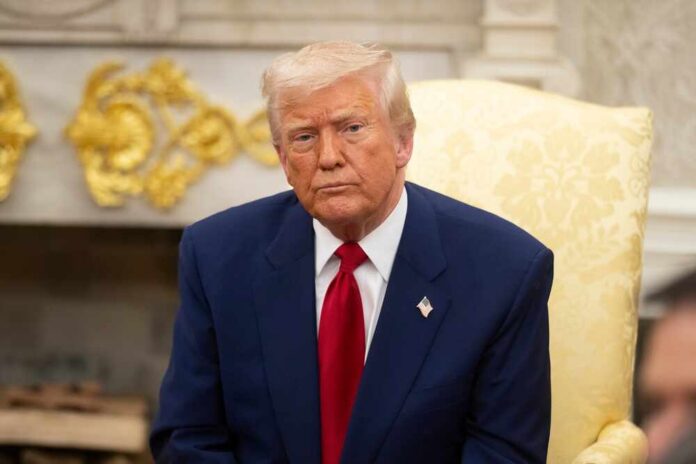
President Trump promised “tremendous numbers” of pardons before he leaves office, and his track record says he means it.
Story Snapshot
- Trump pledged large-scale pardons in a televised 60 Minutes interview.
- He cited protecting officials from what he called political prosecutions.
- He already granted mass January 6 clemency affecting roughly 1,500 people.
- The Constitution gives wide pardon power, historically used in waves.
What Trump Said, Where He Said It, And Why It Matters
President Trump told 60 Minutes he plans “tremendous numbers” of pardons in the back half of his term. He framed it as fairness for people who served the country, saying he does not want them dragged through years of legal fights that he sees as political. The commitment came from the president himself, on national television, not through aides or leaks. That clarity raises the stakes. A public pledge like this invites follow-through and a hard scorecard.
“I intend to issue tremendous numbers of pardons, in fact, I say oftentimes: anybody that got within a thousand miles of the Oval Office,” says President Trump.
Watch the extended interview: https://t.co/3opay4LR9R pic.twitter.com/E5jiQfR7eN
— 60 Minutes (@60Minutes) November 9, 2026
His language was loose on purpose. “Tremendous numbers” leaves room to maneuver. It signals scale without boxing in a number, list, or timeline. It also feeds headlines, which he knows how to do. The promise pairs with a quip about anyone “within a thousand miles” of the Oval Office. That line is not a legal standard, but it shows the protective aim of the policy. The core point stands: he plans to use clemency often and openly.
The Track Record: A Mass Grant On Day One
Words matter less than deeds. On day one of his second term, Trump issued a sweeping action for January 6 defendants. Reports said he granted full pardons and commutations that, in total, covered roughly 1,500 people. That single act shows both authority and appetite. He used the pen quickly and at scale. It also matched a campaign vow to extend broad relief to those cases. Skeptics can argue policy wisdom, but the capacity is no longer in doubt.
The pledge also sits in a long American arc. Presidents have leaned on clemency in moments of tension and reset. George Washington calmed the Whiskey Rebellion with amnesty. Thomas Jefferson unwound the Alien and Sedition Acts with pardons. Abraham Lincoln and later presidents used mercy to mend a country after conflict. The power exists to temper law with judgment when the system needs a release valve. That pattern makes a coming wave plausible, not shocking.
The Law: What A President Can Do And How It Usually Works
The Constitution grants the president broad clemency power for federal crimes. That includes pardons, commutations, and remissions. Congress cannot narrow the core power, though it can fund process support at the Department of Justice. The Office of the Pardon Attorney reviews many petitions, but presidents can act outside that channel. Modern practice varies widely. Some presidents trickle out grants for years; others cluster big actions near milestones.
Raw volume context helps. The Department of Justice has tracked tens of thousands of clemency actions across the last century, mixing pardons and commutations. The numbers swing by era and by president. Many petitions get denied or left unresolved, while a focused set receives relief. That uneven history is why “tremendous numbers” reads as a policy direction, not an exact count.
Who Might Be In Line, And What It Signals Politically
Trump’s stated aim points first to people tied to his administration and to cases he sees as politicized. He suggested he wants to shield public servants and allies who got pulled into investigations he calls unfair. Supporters hear protection against lawfare. Critics warn about favoritism. The first-day January 6 clemency already defined the frame. Any large new wave will be read through that lens, for better or worse.
American conservative values set a simple test. Equal justice requires clear rules, but mercy is not weakness. It is a constitutional tool to correct excess and restore balance. If Trump uses pardons to address overcharging, stacked penalties, or drawn-out process, that tracks with prudence and limited government. If cases involve fraud, violence, or abuse of public trust, the bar should be high and the reasoning spelled out. Results, not rhetoric, will decide the verdict.
What To Watch Next: Signals, Systems, And Scope
Watch for structure. A White House framework, a visible review lane at the Department of Justice, or posted criteria would telegraph scale and pace. Monitor timing clusters around legislative fights, court rulings, or end-of-term windows. Track categories: public corruption, national security, process crimes, or protest-related offenses. Finally, compare outcomes to the pledge. If large numbers land and reasoning is transparent, Trump will have matched word to deed.
Sources:
abcnews.com, supremecourt.gov, thehill.com, people.com, en.cibercuba.com