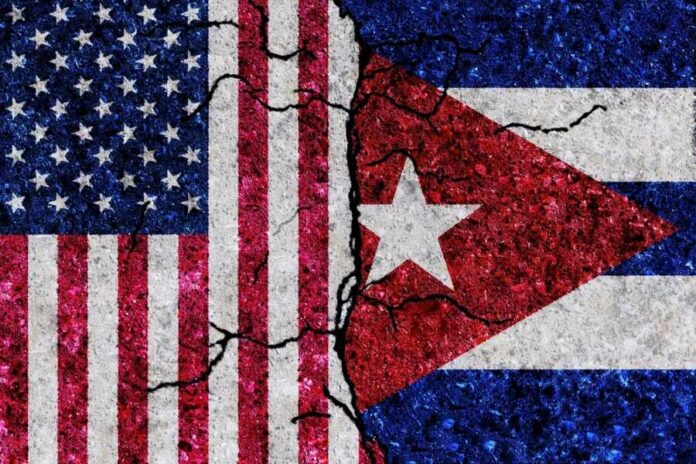
President Trump’s off-the-cuff promise to “take” Cuba lands as the island suffers near-total blackouts—raising hard questions about how far U.S. pressure will go and what legal tools Washington can actually use.
See the video below.
Story Snapshot
- Cuba’s energy system is buckling after oil supplies dried up, with reports of roughly 20-hour daily outages and major blackouts in Havana.
- Trump signed an executive order on January 29 declaring a national emergency involving Cuba and authorizing tariffs on countries that sell oil to the island under IEEPA authorities.
- U.S. pressure has reportedly included blocking oil tankers bound for Cuba, with Mexico’s Pemex shipments a focal point in reporting.
- Cuba’s government has signaled its willingness to talk and announced concessions, including allowing Cuban exiles to invest and own businesses.
Blackouts in Havana Put Cuba’s Communist System Under Maximum Stress
Reporting from March 16–17 describes a steep collapse in Cuba’s power grid, culminating in widespread blackouts in Havana as fuel shortages worsened.
Multiple outlets report daily outages lasting most of the day, plus rationing and disruptions affecting transportation, tourism, and essential services.
Cuba’s crisis is closely tied to oil: after losing its traditional Venezuelan supply earlier in 2026, the island’s aging energy infrastructure appears unable to absorb the shock.
🇺🇸 🇨🇺 US President Donald Trump has vowed to "take" Cuba as the communist island plunged into darkness under a total power blackout linked to a crippling oil embargo imposed by Washington.
➡️ https://t.co/fbnjKHz526 pic.twitter.com/9uNj3vPrJo— AFP News Agency (@AFP) March 17, 2026
Trump’s remarks came as that collapse became impossible to ignore. According to coverage of his White House comments, he framed Cuba as “very weakened” and suggested the U.S. could do “anything” with the island, pairing that rhetoric with a “deal or whatever we have to do” posture.
The available reporting does not show an announced military plan. The concrete actions described focus on energy pressure, economic restrictions, and leverage over third-party suppliers.
The Executive Order Uses Emergency Powers to Squeeze Foreign Oil Suppliers
On January 29, Trump signed an executive order declaring a national emergency involving Cuba and invoking authorities tied to the International Emergency Economic Powers Act (IEEPA).
The order opened the door to tariffs on countries that sell oil to Cuba—an approach that targets the supply chain rather than only punishing Havana directly.
Analysts following the order described it as a significant escalation compared with routine sanctions, especially because it pressures U.S. trading partners.
That structure matters for Americans who care about constitutional guardrails and limited government. Emergency authorities can move quickly, but they also concentrate power in the executive branch.
Reporting notes that the administration’s tariff approach under IEEPA is being tested in court, with the Supreme Court hearing arguments on the broader question of IEEPA-linked tariff authority and a ruling anticipated. If the Court narrows that power, the administration may need Congress to lock in long-term policy.
Oil Tanker Interdictions Resemble a “Blockade” in Effect—If Not by Name
Several sources describe U.S. actions that amount to a de facto oil blockade: intercepting or blocking tankers headed to Cuba and warning suppliers about consequences.
One practical outcome of the reporting is Mexico’s state oil company, Pemex, suspending shipments under U.S. pressure.
Historically, Americans remember that the last time “blockade” language dominated Cuba policy was the 1962 missile crisis; current coverage frames these interdictions as the most direct shipping disruption in decades.
The humanitarian reality on the island is the unavoidable second-order effect. Coverage indicates that the Treasury Department allowed the limited resale of Venezuelan oil to Cuba for humanitarian purposes, but the amounts described do not appear to meet national demand.
In other words, the squeeze appears designed to force political change, while narrow licensing tries—at least on paper—to avoid the worst outcomes for ordinary people. The reporting does not provide enough detail to quantify how much oil is reaching the island.
Havana Offers Concessions as Exiles Gain a New Opening
Under mounting strain, Cuba’s leadership has signaled talks with the United States and announced policy changes allowing Cuban exiles to invest and own businesses.
That is a notable shift for a communist system that long treated exile capital as politically toxic. The reporting frames these concessions as a response to the energy emergency and the tightening external pressure.
It also highlights the political role of Cuban-American lawmakers pushing for harsher measures, including debates over flights and remittances.
For U.S. conservatives, the key is separating dramatic rhetoric from verifiable policy. Trump’s “take” language is attention-grabbing, but the documented levers are economic: emergency declarations, tariff threats against third-country sellers, and maritime pressure that chokes off fuel supplies.
The biggest unknown is durability. If the Supreme Court trims IEEPA tariff authority, the administration’s Cuba squeeze could either shift to clearer statutory footing through Congress—or face legal limits that force a change in strategy.
Sources:
https://time.com/article/2026/03/17/cuba-economic-energy-crisis-trump-us-explainer/
https://en.wikipedia.org/wiki/2026_Cuban_crisis