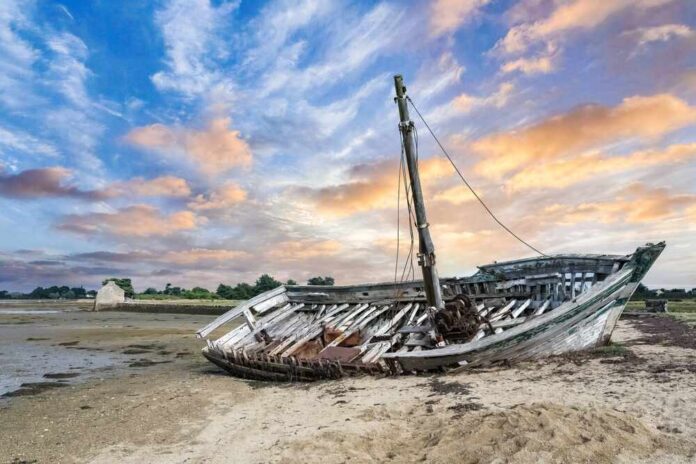
A 400-year-old Swedish naval warship has dramatically emerged from the depths of Stockholm’s waters, revealing a forgotten piece of maritime history buried since Queen Christina deliberately ordered it scuttled as a bridge foundation in the 1640s.
Story Snapshot
- 17th-century Swedish Navy warship resurfaces off Stockholm’s Kastellholmen island after 400 years underwater, exposed by Baltic Sea levels at a 100-year low
- Ship was one of five deliberately sunk around 1640 to form bridge foundations when Queen Christina relocated the naval shipyard due to her dissatisfaction with the castle view
- Baltic Sea’s unique cold, low-salinity, shipworm-free environment preserved the oak hull in exceptional condition despite centuries submerged
- Prolonged high-pressure weather systems pushed Baltic water toward the North Sea and Atlantic, creating record-low water levels and revealing the forgotten wreck
Royal Whim Becomes Historical Treasure
The Swedish Navy warship served from the late 16th to early 17th century before Queen Christina ordered its unconventional retirement around 1640.
The queen relocated Stockholm’s major naval shipyard in the 1630s-1640s simply because she disliked the view from her castle, according to marine archaeologist Jim Hansson of the Vrak Museum of Wrecks.
Rather than waste valuable materials, practical-minded shipbuilders sank five decommissioned oak warships in rows to serve as durable bridge foundations connecting to Kastellholmen island, then the heart of Sweden’s naval operations. This resourceful infrastructure approach transformed military vessels into literal building blocks of Swedish maritime expansion.
Nature Reveals What History Forgot
Prolonged high-pressure weather patterns across the Nordic region since early February 2026 displaced massive volumes of Baltic Sea water toward the North Sea and Atlantic Ocean, dropping water levels to their lowest point in approximately a century.
The exceptional conditions exposed the wreck’s oak hull planks prominently for the first time since 1640, far more dramatically than a brief 2013 emergence.
Hansson emphasized the weather-driven phenomenon rather than climate change as the primary cause, noting water levels may rise again with changing atmospheric conditions. The timing provided researchers an unprecedented window to study the vessel’s construction before the Baltic waters potentially reclaim it.
Baltic Preservation Creates Time Capsule
The Baltic Sea’s unique environmental characteristics created ideal preservation conditions that safeguarded the warship’s structural integrity across four centuries.
Cold temperatures, low salinity levels, and the complete absence of wood-destroying shipworms prevented the biological decay that typically destroys wooden vessels within decades in warmer oceans.
Hansson explained the practical 17th-century logic: “Instead of using new wood, you can use the hull itself, which is oak,” highlighting the durability that made these vessels valuable even in death.
This natural preservation rivals museum-quality conservation, keeping the hull skeleton remarkably intact and enabling detailed archaeological study of construction techniques from Sweden’s naval expansion era under Queen Christina’s reign from 1632 to 1654.
Ongoing Research Seeks Ship’s Identity
The Vrak Museum of Wrecks integrated the rediscovered vessel into “The Lost Navy” research program, a collaborative effort systematically identifying and dating Swedish naval wrecks throughout the Baltic region.
While archaeologists confirmed the ship as one of five deliberately sunk for bridge foundations, its specific identity remains uncertain among candidates, including vessels nicknamed “small Leon” or “Dutch rose.”
Hansson noted that the wreck “has a great story but has been forgotten until now,” emphasizing both its historical significance and the lack of documentation.
The research team focuses on non-invasive study methods, documenting the exposed hull through photography and measurement rather than salvage operations, learning from Sweden’s experience with similar discoveries, including the Vasa’s sister ship in 2022 and various artifact-laden wrecks in 2024.
Naval shipwreck emerges in Sweden after being buried underwater for 400 years https://t.co/SoBeXVMp6a
— CBS Mornings (@CBSMornings) February 18, 2026
The discovery reinforces Sweden’s commitment to maritime heritage preservation while providing Stockholm residents and tourists with visual access to a tangible connection to the nation’s 17th-century naval power.
The wreck’s emergence serves as a reminder that history lies just beneath the surface, waiting for the right conditions to reveal stories of practical engineering, royal decisions, and the resourcefulness that characterized Sweden’s age of maritime expansion.
As water levels fluctuate with weather patterns, researchers race to document this rare glimpse into forgotten infrastructure that supported one of Europe’s most formidable naval forces.
Sources:
17th-century wreck reappears from Stockholm deep after drop in sea levels
Navy shipwreck emerges in Baltic Sea, Sweden