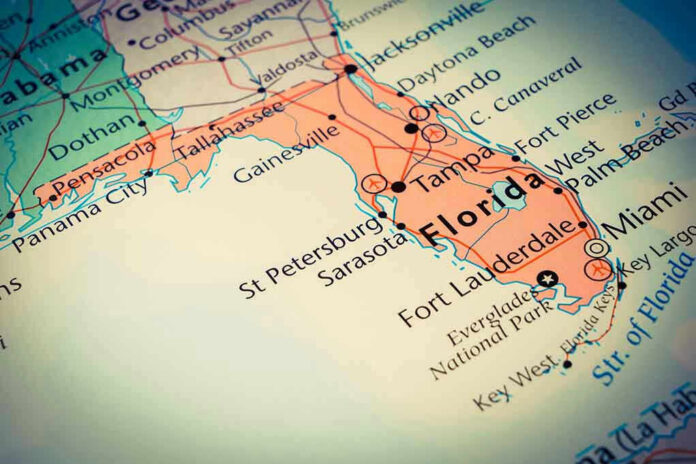
Florida’s latest deadly alligator attacks prove that “rare” does not mean “remote enough to ignore” when you step into warm, shallow water.
Story Snapshot
- One woman dead and two people injured in separate Florida alligator attacks over just a few days.
- Attacks happened in places people saw as safe: a clear river, a lake for paddling, and a marked hiking trail.
- Officials repeat the same warnings, while the real problem is a gap between posted rules and human behavior.
- Statistics say your odds of a serious bite are tiny, yet simple mistakes put you right in that tiny slice.
Three attacks that shattered the idea of “safe enough”
Officials in Florida are on edge after a series of alligator attacks left one woman dead and two others injured, including a child. One attack happened on the Rainbow River in Marion County, where a snorkeler was bitten badly enough that deputies closed the river on June 21.
Another involved a hiker on the Bird Rookery Swamp trail in Collier County, where an alligator came out of the water and grabbed her arm and leg as she walked the trail near a swamp edge. A third, and most brutal, struck in the Econlockhatchee River near Orlando, where a 31-year-old woman cooling off after a hike had both arms bitten off and later died.
These three cases share one key trait: people were close to the water, doing normal things that felt safe, in places the public treats as recreation zones.[1][2][3][8]
13-foot alligator captured after woman dies in attack in Central Florida https://t.co/qHResSbNSb
— WWL-TV (@WWLTV) June 29, 2026
Florida Fish and Wildlife Conservation Commission officials responded with familiar advice: be aware of your surroundings and treat every freshwater body in Florida as potential alligator habitat. That warning is not theory.
Over the last decade Florida has averaged about eight unprovoked bites per year that required medical care, with roughly one in 3.1 million residents seriously injured.
From 1948 to 2022, there were 453 unprovoked bite incidents and 26 deaths. The odds look tiny on paper, but the numbers hide an important pattern. Almost all serious attacks happen when someone is within a few feet of the water’s edge, often during warm months and daylight when people relax their guard.[1][2][5][6]
Rules for living with predators in a crowded state
Florida cannot fence off every river, creek, and pond. Alligators live in all 67 counties and move freely through connected wetlands. So the state leans on a simple rule set that puts responsibility on both sides: strong personal caution and targeted removal of problem animals.
The Fish and Wildlife agency runs a Statewide Nuisance Alligator Program with a toll-free hotline, 866-FWC-GATOR, so residents can report any alligator they feel is a threat to people, pets, or property.
When someone calls, trained trappers are sent to capture and remove that specific animal. This is classic limited-government thinking: focus state power on clear threats while expecting adults to manage their own risk in everyday life.[2][4][6]
The same balance shows up in the official safety tips. Wildlife experts tell people to swim only in designated swimming areas and only during daylight hours, because alligators are most active between dusk and dawn. They urge pet owners to keep dogs and cats on leashes and at least ten feet from the water, since small animals look exactly like natural prey.
Feeding alligators or tossing fish scraps in the water is illegal and strongly discouraged, because it trains the animals to link humans with food and turns a shy reptile into a bold one. These are not complicated rules. They are basic, common sense ways to share land with apex predators without inviting them into your lap.[1][2][6]
Where warnings end and personal responsibility begins
The latest attacks raise hard questions about how far the state’s duty to warn really goes. At the Collier County trail, reporters note that signs warning about alligators are posted along the Bird Rookery Swamp path, yet a woman was still attacked near the water.
At the Econlockhatchee River site, forestry officials have not yet confirmed whether specific warning signs were in place at the Barr Street Trailhead where the fatal attack occurred. Critics claim missing or unclear signs show negligence.
That is an emotional reaction, but it ignores reality on the ground. In a state where nearly every natural body of water can hide a large predator, the idea that a lack of a sign equals safety simply does not match the facts.[3][8]
Statistics reinforce this point. Since 1948, Florida has recorded hundreds of unprovoked alligator bites but only a few dozen fatalities. Most victims were residents, not tourists, and many were swimming, wading, or standing close to the shoreline when the attack happened.
Older adults and pet owners have been part of recent high-profile deaths, such as an 85-year-old woman killed while walking her dog near a community pond in 2023.
Those cases highlight a tough truth: posted warnings matter, but they cannot replace the need to keep your body, your kids, and your pets away from water edges in alligator country. Responsibility has to live at the level of personal choices, not just laminated signs.[3][6][10][11][14]
Why “rare” can still demand respect
Media outlets often stress that serious injuries from alligator encounters are rare. That is accurate and useful. It keeps panic in check and prevents heavy-handed calls to drain wetlands or turn every river into a theme park ride.
At the same time, it can dull the edge of caution. When people hear “one in 3.1 million,” they picture lottery odds, not the way risk concentrates in specific spots and behaviors.
A Florida resident who never goes near natural water has almost zero risk. A resident who swims in warm rivers at dawn, lets their dog drink from pond edges, or stands in swamp shallows several times a week quietly moves into that narrow band of danger where rare events actually happen.[3][4][6][7]
The way to read these attacks is clear. The state should keep running its nuisance removal program, keep updating factual risk numbers, and keep punishing people who feed wild alligators.
But adults must stop outsourcing judgment to signs and social media clips. Nature is not a lawsuit waiting to happen; it is a set of harsh rules that do not care whether you saw a warning or not.
Florida’s latest tragedies are not proof that the system is broken. They are reminders that living free in a wild place demands something many modern people have forgotten how to give: steady attention, respect for the water’s edge, and the humility to back away before teeth and speed make the odds feel very personal.[2][4][6][10]
Sources:
[1] Web – Florida alligator attacks leave woman dead, 2 others injured, …
[2] Web – What You Need to Know About Alligators Before Hiking or Paddling …
[3] Web – Alligator Safety – Visit Gainesville
[4] Web – Alligator Safety Tips in Florida Whether you’re kayaking, swimming …
[5] YouTube – Deadly wildlife encounters spark safety warnings ahead of July 4th
[6] Web – Safety Tips for People and Pets – FWC
[7] Web – There have been a total of three reported alligator attacks in the …
[8] Web – Alligators in Florida and safety precautions – Facebook
[10] Web – 31 year old woman killed in alligator attack on the econlockhatchee …
[11] YouTube – Trail closed after gator attack in Florida river leaves 31-year-old …
[14] Web – What to do when encountering an alligator on a trail in Florida?