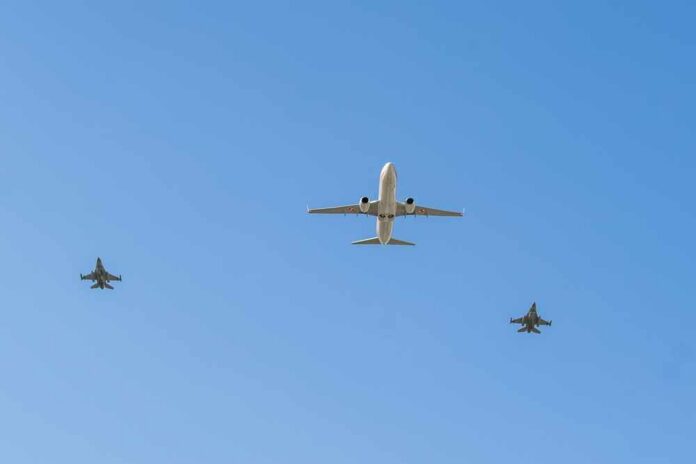
An F-16 made a dramatic close pass to yank a wayward small plane out of restricted airspace near President Trump’s Palm Beach stay—and it worked.
Story Snapshot
- NORAD said an F-16 intercepted a civilian plane inside a Palm Beach no-fly zone and escorted it out.
- 1st Air Force logged the intercept near 10:49 a.m. Eastern and confirmed the plane landed safely.
- FAA rules warn pilots that violating a presidential restriction can trigger an intercept.
- CBS described a close “headbutt” style pass that got the pilot’s attention and compliance.
What Happened Over Palm Beach
North American Aerospace Defense Command reported that an F-16 intercepted a civilian aircraft that entered a temporary flight restriction over Palm Beach, Florida. The command said the fighter escorted the plane out of the protected airspace without incident. First Air Force added time and place, noting the response at about 10:49 a.m. Eastern and confirming that all aircraft landed safely. This sequence matches standard playbooks for airspace security when a pilot strays into a VIP-protection zone.
CBS News reported that the fighter made a close pass in front of the small plane to get the pilot’s attention around midday. The pilot then radioed and followed directions to exit the area. Reporters called the pass a “headbutt maneuver,” a vivid phrase for what amounts to a controlled, in-front flyby that signals, “Look at me, then turn and follow.” The military accounts did not use that label, but they confirm the intercept and the safe outcome.
Why A Fighter Shows Up Fast
The Federal Aviation Administration uses temporary flight restrictions to protect the President and other officials. The Palm Beach restrictions broadcast a clear warning: break the rules and you may be intercepted. Controllers and air defense crews watch those rings closely. If an aircraft enters without clearance or stops communicating, the response shifts from a radio problem to a national security problem in seconds. The first goal is not punishment; it is to establish contact, confirm identity, and move the aircraft to safety.
Standard intercept procedures are simple and strict. The fighter approaches, establishes visual signals or radio contact, and directs the pilot to turn or follow. The intercepted pilot must comply at once and remain predictable until released. That is not a suggestion; it is the rule in the Aeronautical Information Manual and related guidance meant to prevent confusion and collisions. The Palm Beach escort aligns with those instructions and with recent cases elsewhere where fighters guided civilian aircraft out of restricted zones.
The “Headbutt” Explained In Plain Terms
Pilots respond best to clear cues. A fighter crossing in front, slightly above and ahead, fills the windscreen and leaves no doubt who is in charge. This is not a game of chicken. It is a controlled geometry that signals “turn now and follow me,” backed by hand signals and radio prompts. Media chose the word “headbutt,” but doctrine describes a close pass, roll-out, and rejoin to verify compliance. The Palm Beach pilot complied and exited, which is the point of the maneuver.
A military fighter jet used a "headbutt maneuver" Saturday to intercept a civilian aircraft that entered restricted airspace near President Donald Trump's Mar-a-Lago resort in Palm Beach, Florida. https://t.co/CYySLTAp0Y
— NEWSMAX (@NEWSMAX) October 26, 2026
Some readers ask whether a fighter should take such a bold line with a private pilot. The facts support it. A presidential restriction is not a suggestion; it is national security policy. Conservative common sense says boundaries matter, warnings should be clear, and consequences must be swift but measured. An intercept that uses visibility instead of violence meets that test. It protects the President, the public, and the errant pilot by ending the violation fast while avoiding escalation.
What We Still Do Not Know
Officials did not publish the small plane’s tail number, flight path, or the pilot’s explanation. That is normal while agencies handle safety and enforcement steps. The core is settled: the aircraft violated a temporary flight restriction, the fighter intercepted, the pilot complied, and everyone landed safely. The Federal Aviation Administration’s published notice for Palm Beach presidential movements shows why crews were ready and why the aircraft faced an intercept warning from the start.
Why This Fits A Larger Pattern
Temporary flight restriction busts happen across the country. When the President travels, the sky around him tightens. Air defense sectors, controllers, and fighter crews practice this dance often. In 2023, North American Aerospace Defense Command described a similar intercept over Delaware, with a fighter and a helicopter guiding a civilian aircraft back out of a restriction. The message is steady: if you stray into the ring, expect a rapid intercept, firm direction, and a safe exit when you comply.
Bottom Line For Pilots And The Public
Pilots must check notices, monitor guard frequencies, and call early if unsure. The cost of guessing near a presidential site can be a fighter off the wing. For the public, the takeaway is calm confidence. The system worked as designed in Palm Beach. The fighter got the pilot’s attention, enforced the boundary, and kept everyone safe. That is security done the American way: clear rules, swift response, and minimal force to end the problem.
Sources:
cbsnews.com, norad.mil, 1af.acc.af.mil, tfr.faa.gov, yahoo.com