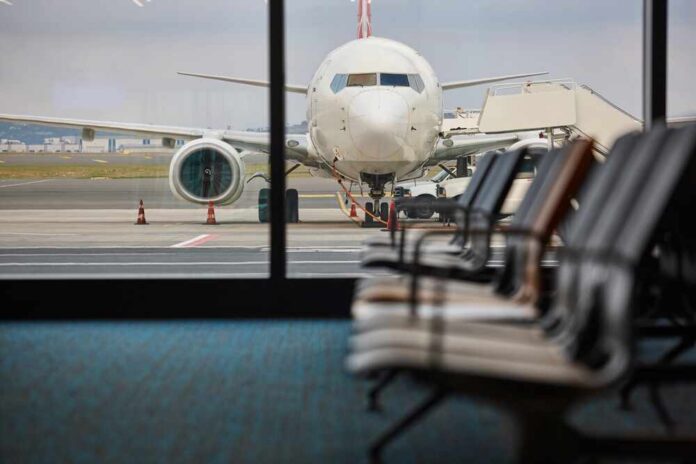
More than a thousand flights ground to a halt this week after the country’s air traffic control provider hit a technical wall it still could not fully explain by day’s end.
Quick Take
- National Air Traffic Services (NATS) reported a technical issue that disrupted departures at Heathrow, Gatwick, Manchester and Stansted.
- NATS engineers were sent on site immediately to investigate and restore normal flight processing.
- The outage fits a known pattern of past NATS failures tied to flight-data and radar systems, not sabotage.
- Regulators and lawmakers have repeatedly demanded answers from NATS leadership after similar past breakdowns.
What Went Wrong At Britain’s Busiest Airports
NATS confirmed it was “investigating a technical issue which is causing some disruption to flight departures,” adding that engineers were already on site working the problem.
The disruption hit some of the busiest airports in Europe at once. Heathrow, Gatwick, Manchester and Stansted all faced restrictions and delays as controllers scrambled to manage the fallout without compromising safety.
1,055 Flights cancelled after UK air traffic control glitch.
"It's just an absolute nightmare down there," healthcare worker Josie Donoghue said of Gatwick after leaving the airport, having had to disembark her flight to Ireland after three hours stuck on the runway… pic.twitter.com/VSPRzTgIo2
— AFP News Agency (@AFP) September 9, 2026
Airlines canceled flights in bulk rather than risk unsafe congestion in UK airspace. That decision follows a well-worn safety playbook.
When automated systems falter, air traffic controllers throttle traffic and lean on manual backups instead of letting planes stack up in the sky. It is a slower process, but it is the one that keeps passengers safe while engineers chase down the root cause.
A Pattern British Aviation Knows Too Well
This is not the first time NATS systems have buckled under pressure. In August 2023, a flight-plan processing failure triggered by a single rare flight plan grounded thousands of flights over a bank holiday weekend, stranding passengers nationwide.
That earlier meltdown pushed the Civil Aviation Authority to launch an independent review into the causes and NATS response.
A separate 2014 failure traced back to a latent software defect in NATS systems, one that had existed since the 1990s before finally surfacing during a system update.
And in a more recent radar-related episode, a fault lasting only 20 minutes still managed to ground roughly 150 flights and cause delays that stretched into the next day. The common thread is clear: small technical faults in highly automated systems can cause outsized disruption fast.
Lawmakers And Airlines Want Straight Answers
Britain’s transport secretary has previously demanded answers directly from NATS leadership after flight disruptions tied to technical failures at the Swanwick control center.
NATS chief executive Martin Rolfe has been hauled in front of lawmakers for questioning after past outages rattled the flying public and cost airlines heavily in compensation and rebooking costs.
The 2023 breakdown alone triggered more than 2,000 cancellations and left airlines facing compensation payments running into the millions of pounds.
That kind of financial and reputational damage explains why officials move fast to demand transparency every time NATS systems go down, even when the underlying cause turns out to be a rare technical glitch rather than anything sinister.
Why This Keeps Happening And What It Means For Travelers
Air traffic control across Britain runs on decades-old automated infrastructure layered with modern updates. That combination works well most days.
But when a rare data combination or software quirk slips through, the system can stall fast, and there is little room for error when hundreds of aircraft are counting on precise coordination every minute.
For travelers, the practical lesson is blunt. Check flight status directly with airlines before heading to the airport whenever NATS reports any technical issue, since disruptions can cascade across multiple airports within hours.
Airlines and regulators will sort out compensation and accountability later. In the moment, safety-driven caution, even when it means mass cancellations, remains the right call every time.
Chaos continues across UK airports as airlines struggle to recover from a major air traffic control failure.
Around 2,000 flights have now been cancelled across Tuesday and Wednesday, leaving hundreds of thousands of passengers affected and aircraft and crews stranded in the…
— Naveed Khan (@i_Naveediqbal) September 9, 2026
Britain’s aviation system has weathered these technical storms before and rebuilt public confidence each time through independent reviews and public accountability sessions with Parliament.
That track record suggests this latest disruption, however painful for stranded passengers this week, will follow the same script: a technical explanation, a formal review, and pressure on NATS to make sure it does not happen again.
Sources:
thegatewaypundit.com, aljazeera.com, bbc.com, airhelp.com, flightglobal.com, bbc.co.uk, abcnews.go.com