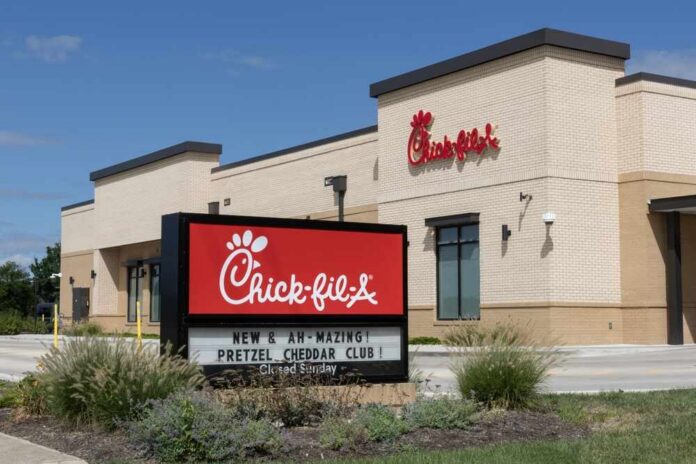
A Chick-fil-A franchisee in Texas now faces a federal fight that turns on one sharp question: was this a scheduling dispute, or a religious-accommodation failure that crossed the line?
Quick Take
- The Equal Employment Opportunity Commission says the employee told the franchisee she could not work from sunset Friday to sunset Saturday because of Sabbath observance [1].
- The complaint, as reported, says the restaurant initially accommodated her request before later requiring her to work on Saturdays [1].
- The employee was allegedly offered a lower-paying delivery driver role with fewer hours and benefits, instead of continued Sabbath accommodation [1].
- The case matters because Title VII of the Civil Rights Act of 1964 requires reasonable religious accommodation unless the employer can show undue hardship [1].
How the Dispute Began
The dispute centers on Laurel Torode, whom the Equal Employment Opportunity Commission says disclosed during hiring that her faith barred her from working on Saturdays.
According to the complaint described in media reports, she joined Hatch Trick, Inc., the Austin-area franchisee, with an understanding that the Sabbath restriction would be respected.
The reported sequence matters more than the branding noise around it: an accommodation was allegedly granted, then later pulled back, and that is where many workplace religion cases turn from awkward to legally combustible [1][2].
The reported timeline is what gives the case its force. FOX Business says the company later told Torode she would need to work Saturdays, including the period when she observed the Sabbath, and that she sought alternatives to keep her management role without violating her beliefs [1].
That is the kind of fact pattern federal investigators watch closely because it tests whether an employer truly tried to work around a religious practice or simply tolerated it until the inconvenience became too much.
Why the Accommodation Offer Became the Flashpoint
The alleged substitute offer is where common sense and employment law start to collide. FOX Business reports that the company told Torode she would need to accept a lower-level delivery driver job with reduced pay, fewer hours, and diminished benefits if she wanted to avoid Saturday shifts [1].
If that account holds, the employer did not merely ask for flexibility; it allegedly offered a pay cut as the price of conscience. That detail will matter enormously in court because it suggests the accommodation may have come with a penalty.
The Equal Employment Opportunity Commission brought the case in federal court in Austin after attempting to resolve it administratively without success, according to the same report [1].
That does not prove liability, but it does tell readers something important: a federal agency believed the facts were strong enough to litigate under Title VII.
For those who follow these disputes, the key issue is not whether a business can run a schedule; it is whether the business can demand a religious exception one month and deny it the next without a convincing operational reason.
Why This Case Resonates Beyond One Restaurant
This case lands in a cultural pressure cooker because Chick-fil-A already carries a public identity tied to religious conviction and Sunday closure. That irony makes the story easy to flatten into a punchline, but the legal question is narrower and more serious.
The law does not ask whether the company has a faith-friendly reputation; it asks whether this specific franchisee reasonably accommodated a specific worker’s religious observance.
CHICK-FIL-A FRANCHISEE SUED OVER SABBATH FIRING CLAIM
A Texas Chick-fil-A operator is facing a federal lawsuit after allegedly firing an employee who refused to work Saturdays for religious reasons.
The EEOC says the company initially accommodated her Sabbath observance before… pic.twitter.com/nDtg1VpMPn
— NewsForce (@Newsforce) May 20, 2026
The available reporting also shows how quickly a one-sided narrative can harden. FOX Business and other outlets repeated the same core sequence: Sabbath request, initial accommodation, later Saturday scheduling, and termination after the employee declined the alternative role [1][2].
That repetition does not replace evidence. It does, however, explain why the case already feels familiar to anyone who has watched employment disputes become moral dramas long before a judge sees the file. The missing piece is the franchisee’s detailed defense.
What Still Needs To Be Proven
The current record is still mostly a complaint-by-summary story, not a fully tested trial record. The available reports do not include the franchisee’s answer, a motion to dismiss, or sworn testimony from the owner or managers [1][2].
That matters because the employer may argue undue hardship, staffing strain, or some neutral business reason for the reassignment and firing. Until those facts surface, the strongest reading is cautious: the allegation is serious, but the defense has not yet been heard in public detail.
Sources:
[1] Web – Texas Chick-fil-A franchisee sued over alleged Sabbath discrimination
[2] YouTube – EEOC sues Austin Chick-fil-A operator over Saturday Sabbath …